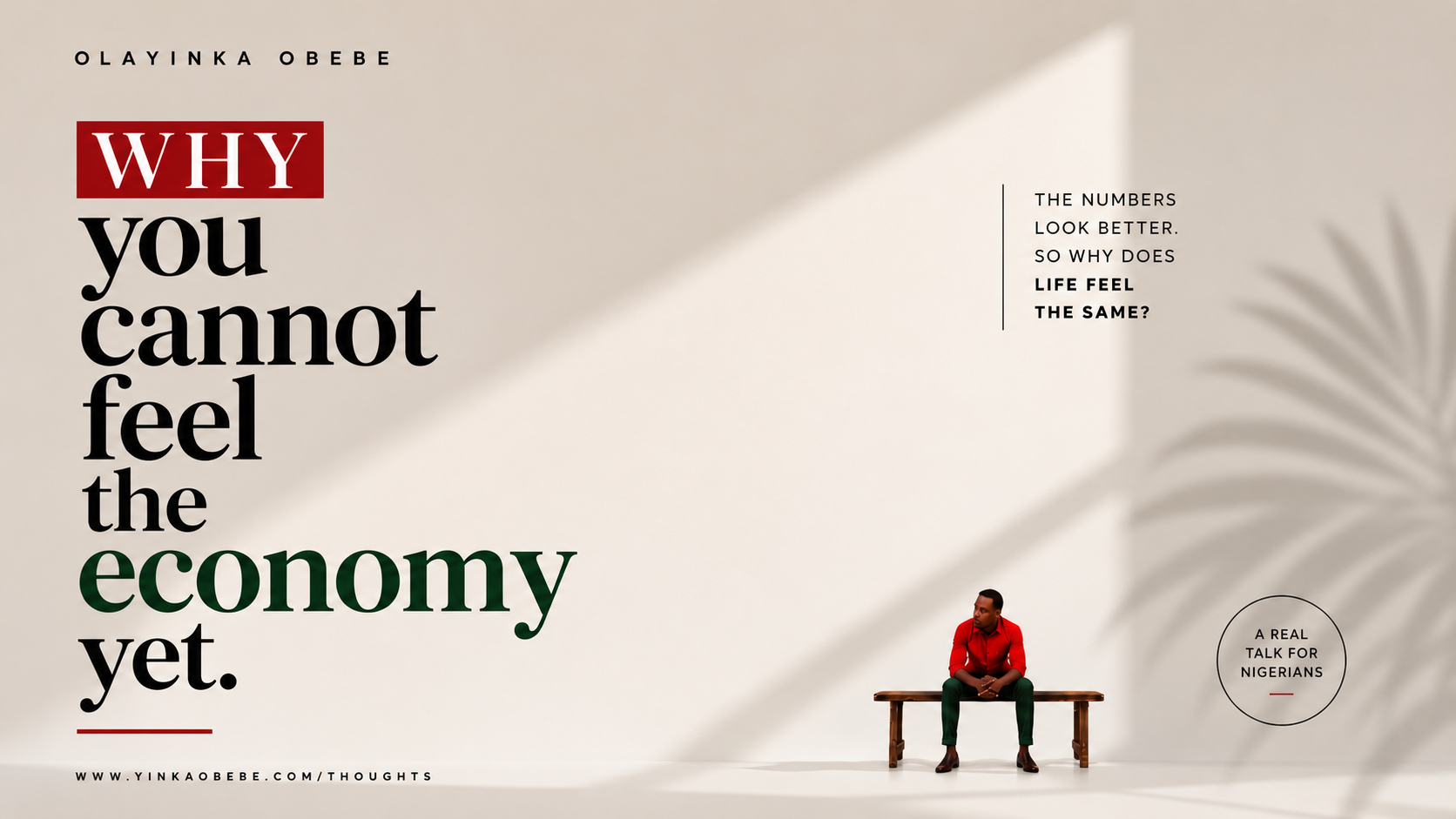
A woman in Mushin counts her change at the end of the day and the math does not add up the way it used to. Same stall. Same hours. That same evening, on the news, a man in a good suit explains that the economy grew. He has charts. He is not lying.
Neither is she.
That is the strange thing about Nigeria right now. Two stories are being told at the same time, and both of them are true. The government says the reforms are working. The naira has firmed, the economy grew about 4 percent late last year, and in dollars it climbed back to over $300 billion plus. The people say they cannot feel it. The pot is smaller. School fees are higher. The salary finishes before the end of the month.
So how can both be true at once. That question is the whole matter. And once you understand the answer, you will start reading economic news differently.
Two Nigerias, one economy
Picture the economy as a building with two floors.
Upstairs is the big picture. Total output, the exchange rate, inflation, the national debt. This is the view from the plane window. From up there you see the shape of the whole country, the weather moving across it. What you do not see is people.
Downstairs is your life. One trader deciding whether to restock. One graduate deciding whether to stay or japa. One mother deciding whether the wage covers transport and still leaves something for food. This is the ground. This is where you and i actually live.
The thing is, policy gets made upstairs. Big levers, pulled from the top. But you live downstairs. So whether anything is really working depends on one thing, whether what happens upstairs ever reaches the ground floor. Sometimes it does. Right now, for most people, it has not arrived. The view from the plane says things are looking up. The view from the street says otherwise. We are simply on different floors.
The scoreboard and the engine
I will try to use this to explain it to you.
GDP is not an engine. It is a scoreboard.
You do not get fit by adjusting the scale in your bathroom. The number on the scale moves because of something you did. GDP is the same. It is the result, not the cause. The country does not get richer because the number rose. The number rises because something underneath it moved.
And what is underneath it is work. Real work. A business makes something. To make it, the business hires people. Those people earn wages. They spend those wages at other businesses, who then hire more people. That loop, make, hire, pay, spend, hire again, is the actual engine. Everything else is just the scoreboard reporting on it.
When the engine is running, the big picture and your life move together. More businesses, more jobs, fatter wages, fuller pots. When the engine stalls, the scoreboard can still climb for a while, but nothing reaches the ground. The number starts to look like a lie.
And in Nigeria the number has been appearing like it’s lying for four reasons. Once you notice them, the whole confusion ends.
The first is the kind of growth that does not hire anybody. Oil is the clearest example. A barrel of crude adds money to the national figure, but it does not need a massive workforce. So the economy grows and the job market does not even feel it.
The second is when the money pools at the top. A few people get much richer, the average climbs, and the country looks more prosperous on paper. But most people never touched that money. The average moved. The middle did not.
The third is when the growth is really just arithmetic. Last year Nigeria recalculated how it measures the economy and it became about a third bigger overnight. No new factory opened that morning. Nobody got hired. Somebody simply changed how the sum was done. The currency does this in reverse too. When the naira loses value, the economy can shrink in dollars even while the country produces exactly the same amount of everything. So it’s not a lie.
The fourth is the one biting hardest. Even when the economy genuinely grows, two things eat the gain before it reaches you. Inflation, which makes everything cost more. And population, because we are adding people fast. If the economy grows 4 percent and the population grows just as fast, the average person is standing still. Then prices will push them backwards. The growth was real. It just got eaten up.
Put those four together and the quarrel between the two Nigerias makes sense. The government is reading a scoreboard that genuinely moved. The people are standing where the engine never reached. Nobody is lying. The wire between them is simply loose.
The trillion-dollar dream, in plain numbers
Now the big promise. A one trillion dollar economy by 2030. It is a serious goal and it deserves a serious look. Let us actually count and calculate it.
Nigeria today is about a $300 billion plus economy. The target is a trillion. That is not a small step. That is more than double, in five years.
To get there, the economy would have to grow about 27 percent every year, for five years straight. For a sense of scale, China's greatest decade, the one that pulled hundreds of millions out of poverty and stunned the world, grew at around 10 percent a year. So the figure Nigeria is reaching for is, on paper, steeper than the most famous economic miracle in living memory.
That does not make it a fantasy. It makes it conditional. And there is a quiet catch. Because the target is counted in dollars, a big part of it rides on the naira, not just on the work we do. If the naira strengthens, the dollar figure jumps even when nothing new is built. If the naira slips, you can work all year and watch the number fall anyway. That is part of why last year looked good. The naira recovered. Much of that was just winning back ground we had already lost.
So let’s say we do it. Say Nigeria really reaches a trillion dollars by 2030. By then we will be around 255 million people. Share a trillion dollars across 255 million people and it comes to roughly $3,900 each, for the year.
Today that figure is around $1,500. So a trillion-dollar Nigeria would more than double what the average person has. That is real. That is worth wanting. A family at $3,900 a head has options a family at $1,500 does not.
And still. $3,900 each is not rich. It is breathing room, not comfort. It is still the bottom of the ladder, not the top.
And $3,900 is an average, and an average hides almost everything. The same average can sit on two completely different countries. In one, a few very rich people sit at the top and most people stay poor, and the number looks fine because of the few at the peak. In the other, a wide working middle class actually holds the money, and the average reflects ordinary lives. The trillion-dollar headline cannot tell you which Nigeria you would be waking up in. Only the engine underneath can do that.
So it was never whether we touch a trillion. It is this. If we do, how much of it would reach a house in Aba, in Kano, in Benin City. The number was never the prize we have been talking about. The reach is the prize we should be discussing..
How other countries did it
This is not guesswork. Others have run this same race, and they tend to teach the same lesson.
Singapore had no oil, no land, almost nothing. In the 1960s it was poorer than Nigeria. Today its people are among the richest on earth. It did not happen by luck. The government went after foreign investment on purpose, built public housing that put homes into ordinary hands, and pushed people to save so that growth built wealth for families and not only for companies. They did not wait for the gains to spread. They laid the channels that carried them.
South Korea was poorer than Ghana in 1960. It leaned on factories and exports and schooling, and stood behind its companies, Samsung, Hyundai, until they could beat the world.
China moved hundreds of millions out of poverty with one tool above all the others. Factories. Millions and millions of factory jobs. That, more than anything, is what turns a rising economy into money people can actually feel in their hands.
America's secret is quieter and older. It built things that last. Banks that lend to ordinary businesses. Courts that enforce a deal. Schools and universities in every region. Roads that tie the country into one big market. Programmes that put home ownership and education within reach of millions of ordinary families. A strong economy turns out to be less about one clever policy and more about a stack of dependable institutions, built at home, that keep the engine running and let the gains reach the people.
One thread runs through all of them. None grew rich by accident. In each case somebody laid the path that carried growth into people's homes. Growth never seems to spread on its own. It gets carried.
The part that is easy to miss
So what is the gap here. Listen to what people actually mean when they say they cannot feel the economy. Most of the time they mean they want a job with a payslip.
And the payslip turns out to be everything. Health cover hangs on it. Pension hangs on it. The chance to qualify for a house hangs on it. None of these are gifts handed down from above. They come attached to proper, formal jobs. And proper jobs in large numbers tend to come from one place above all others. Factories. Plants that take what we already grow and dig and turn it into more.
This is the easy thing to miss. Our recent growth has leaned on trade, on services, on a recovering currency. Manufacturing, the part that hires people in real numbers, has been thin, and it barely moved late last year. The scoreboard has been climbing while the engine room has stayed quiet.
And it is not only the giant projects and the summit announcements that count. A lot of the quiet magic sits in the middle. The thousands of ordinary, mid-sized businesses that each employ a couple hundred people. Germany built one of the strongest economies in the world mostly on firms like these, not on a handful of giants. Ten thousand Nigerian factories, each with two hundred people on the payroll, would be two million families inside the system. Two million payslips. Two million households that could suddenly reach cover, credit, a home of their own.
That is usually how a trillion-dollar headline becomes a fuller pot. Not through the number. Through the work underneath it.
So, why can you not feel it yet
Because the scoreboard has recovered faster than the factories. Because the path that carries growth from the big picture down to your kitchen is loose in the exact places it needs to be tight.
The man in the suit is not lying. The woman in Mushin is not lying. They are standing in the same economy, at opposite ends of a wire that has not yet been reconnected. The distance between them is not a scandal. It is the lag between when an economy moves and when a household feels it. Sometimes that lag can be short. Sometimes it stretches for years. What decides it is whether the engine underneath the number is actually running.
A trillion dollars by 2030 is a steep climb, and much of it rides on a currency more than on real work. But even if we get there, the number on its own will not feed anyone. What feeds people is the engine beneath it. The businesses. The factories. The jobs with payslips. The boring, unglamorous institutions that carry the gain all the way to the homes.
When that engine is running, the trillion becomes something you can feel. When it is quiet, the trillion, whenever it comes, stays a number on a screen that the country still cannot eat.