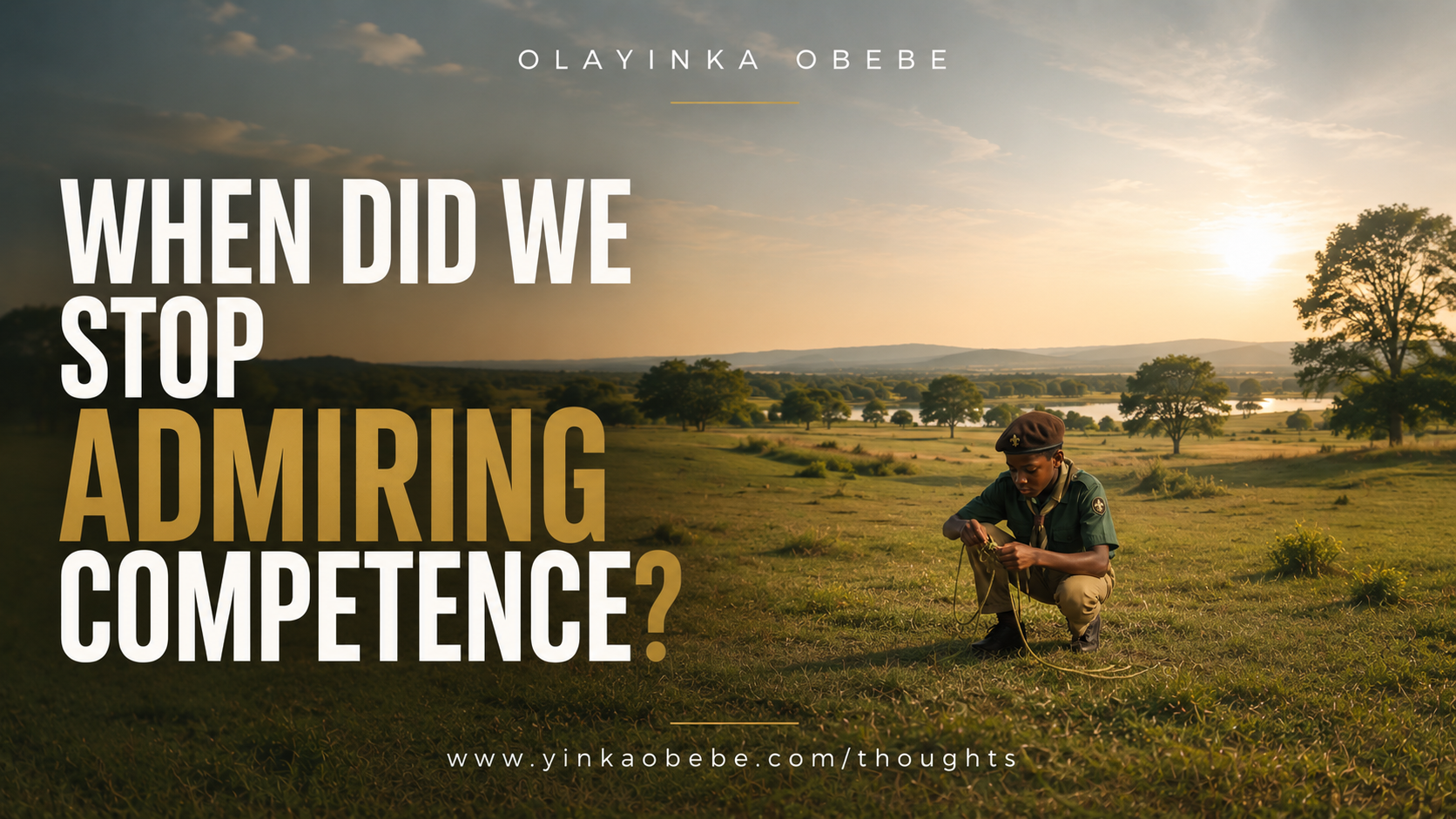
There is something I have been noticing about Nigeria that I have struggled to describe.
It is not exactly about poverty. I can't say it's about education. And this is not even about young people.
It is about what we have decided to admire.
Somewhere along the way, competence has stopped being a status symbol. In many cases, dependence replaced it. Today, there are practical life skills that many people now associate with poverty rather than capability.
Knowing how to change a car tyre. Tying different types of knots. Cooking from scratch. Growing food. Walking long distances. Fixing basic things around the house. Camping. Swimming. Using a map. Building something with your hands.
These are no longer seen as signs of competence. To many people, they are signs that life has not gone well. The assumption is simple: if you have enough money, someone else should do those things for you. That sounds to them like progress.
But it is not.
Comfort and capability are not the same thing. A comfortable person has access to many services, while a capable person needs fewer services. Money can buy comfort, it won't buy competence.
The strange thing is that the countries many Nigerians admire understand this better than we do. Affluent families voluntarily send their children to Scouts. People pay to go hiking, go camping for fun, learn sailing, hunting and spend weekends climbing mountains.
Military academies deliberately teach young men and women how to survive outdoors, navigate without technology, tie knots, repair equipment and solve problems under pressure. They do not expect everyone to live in the wilderness, but because they know that competence compounds. A person who learns to solve small practical problems often becomes someone who can solve larger intellectual ones.
Yet here, those same activities are often dismissed as things people only do because they cannot afford comfort.
We have mistaken convenience for capability. The same misunderstanding exists when people think about elite military units.Many Nigerians imagine that the toughest soldiers are simply the most violent.
They are not, the world's elite military units are built as much on intelligence as physical strength. Candidates are expected to think while exhausted, they must remember complex instructions under extreme pressure. Navigate without GPS. Work in teams. Stay calm. Improvise and learn continuously. Strength may get you through the first day, but competence gets you selected.
We have confused ruggedness with capability. They are not the same thing, the same confusion appears in everyday life.
Listen carefully to the things people would have loved to proudly say.
"I've never entered a bus." "I've never washed clothes." "I've never cooked."
"I've never ironed." "I've never changed a tyre." These are often presented as achievements. But these are really confessions of dependency.
There is nothing wrong with outsourcing tasks, the problem begins when outsourcing replaces understanding. When you become incapable of doing the things you have chosen not to do. Perhaps the most worrying change, however, is not practical. It is intellectual.
Curiosity itself appears to be shrinking. A few days ago I asked some of my security staff whether they knew different ways to tie ropes. They looked surprised. I pointed them towards some military personnel nearby and suggested they ask to be taught. What worries me wasn't that they didn't know. It was that they didn't seem particularly interested in finding out.
That frightened me.
Because civilisation has always advanced through one simple instinct:
"Really? Show me."
Not,
"How much does it pay?"
The most valuable people in any society are usually curious long before they become successful.
That is why another trend worries me.
Around the world, conversations about Artificial Intelligence are focused on helping older workers adapt. Many technology companies assume younger people will naturally embrace these new tools.
My own experience has often been different. I meet young Nigerians who avoid AI altogether. Some dismiss it, fear it, and refuse to learn it.
The issue isn't intelligence. It is the declining habit of learning.
Capability changes with every generation. Thirty years ago, capability meant repairing things, navigating without technology and understanding mechanical systems. Today it also means prompting AI effectively, verifying information, understanding systems and solving unfamiliar problems. The tools should evolve, but the mindset should not.
And then there is the role of culture.
Our television screens are full of competitions that reward performance.
Singing. Dancing. Comedy. Beauty.
But where are the competitions that celebrate craftsmanship?
Engineering. Robotics. Carpentry. Welding. Agriculture. Design. Problem-solving. Survival. Innovation.
A society eventually becomes what it celebrates.
If we celebrate celebrity more than competence, we should not be surprised when young people chase visibility before mastery. This is not an argument against comfort. Nor is it nostalgia for a harder life. It is an argument for rebuilding capability as something worth admiring again.
Imagine if every secondary school graduate left school having demonstrated competence in first aid, swimming, financial literacy, AI literacy, public speaking, cooking, teamwork and basic repairs.
Imagine national competitions with life-changing prizes for engineering, robotics, survival skills, agriculture, craftsmanship and innovation. Imagine rebuilding school sports, not simply to produce athletes, but to teach discipline, resilience, leadership and teamwork.
Imagine television and social media making competence aspirational again, what we encourage is usually what we get. The future will not belong to the people who have been protected from difficulty. Nor will it belong to the people who have simply endured hardship. It will belong to those who can keep learning. Who can solve problems. Who stay curious. Who remain useful in unfamiliar situations.
Our society becomes fragile when competence is now looking like poverty.
Perhaps it is time we admired capability again.