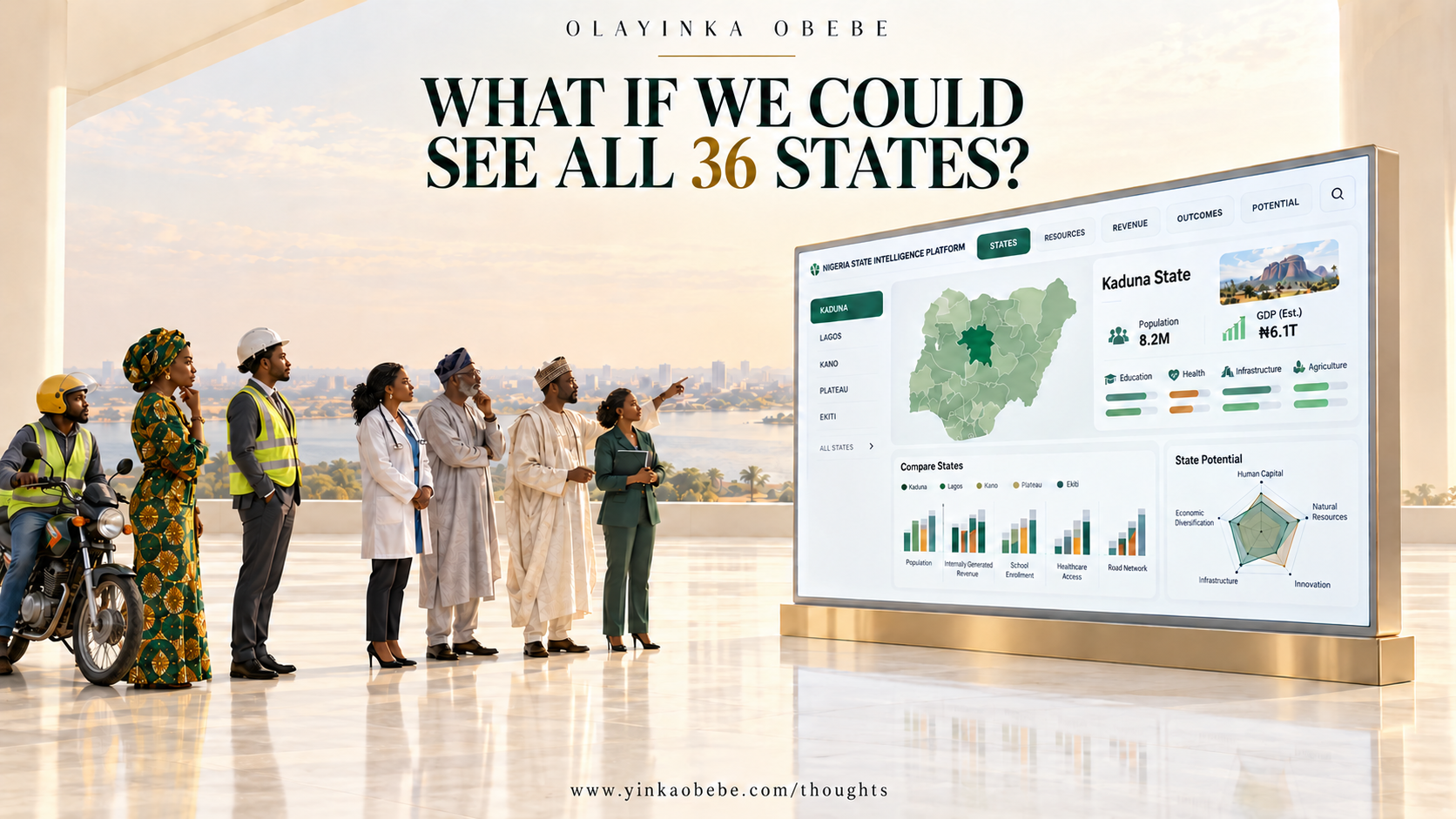
Most Nigerians know the names of our 36 states. We know their capitals. We know their governors. We know some of their slogans. We know which ones are said to be rich, which ones are said to be poor, and which ones are always being compared to Lagos. But how many Nigerian states do we actually understand?
If I opened a page for Kaduna today, what would I find? Would I see how much money the state receives from the Federation Account? How much it generates internally? What it owes? What it spends? What industries already exist there? What its people do for a living? What it imports from other states? What it sells to them?
Would I see how many children are in school, how many teachers are available, what the hospitals can handle, how many businesses are being formed, where investment is entering and which parts of the state are being left behind? More importantly, would I understand what Kaduna is trying to become?
Nigeria produces a lot of public information. Budgets are published. FAAC allocations are announced. Statistical reports are released. Governors present plans. Ministries commission projects. Audit documents appear. Internally generated revenue is reported. The information exists. But it exists in pieces.
A citizen may know that a state received a certain amount from FAAC without knowing the size of its population, its debt obligations or what it already raises internally. Someone may hear that a governor constructed 50 kilometres of road without knowing how many kilometres were promised, what those roads connect or whether they have changed the movement of people and goods. Numbers without context can produce noise instead of understanding.
What if there were one place where every Nigerian state could be seen as a complete system? Not a political website. Not a place created to insult governors. Not another league table that automatically places Lagos at the top and declares everyone else a failure. A living public map of Nigeria, state by state.
You could open any state and see what it inherited: its population, geography, natural resources, institutions, infrastructure and existing industries. You could see the money available to it: FAAC allocations, internally generated revenue, grants, borrowing and annual budgets. You could see what the government said it would do, what it actually funded, what it completed and what changed in the lives of the people. But the platform would need to go beyond measuring spending. It would also need to measure imagination.
What Is Each State Trying to Become?
Nigeria is a federation, but our states do not always behave like distinct economic ideas. Almost every state wants to attract investors, build an airport, establish an industrial park, create jobs and become more like Lagos. But a state should not simply be a smaller copy of another state.
Kaduna has a particular location, population, history and collection of institutions. What could those advantages make possible? Could it become a major centre for manufacturing, agricultural processing, logistics and technical training in northern Nigeria? If that were the ambition, what roads would matter most? What kind of electricity infrastructure would it require? Which crops should feed which factories? What skills would young people need? What businesses should be moving there? What would the state need to do consistently for ten or twenty years?
What should Plateau become because of its climate and landscape? What should Nasarawa become because of its proximity to Abuja? What could Akwa Ibom build around its coastline and existing infrastructure? What should Ekiti’s history of education produce economically? What could Kano become if its commercial history were connected to modern manufacturing, logistics and exports?
These questions are not about creating another slogan. A state’s brand should not merely be what is written beneath its coat of arms. Its real brand should be the role it has deliberately built for itself in the Nigerian economy.
Perhaps we should be able to say that this is the state to study healthcare delivery. This is the state that has solved agricultural storage. This is where technical talent is being trained. This is the easiest state in which to start a factory. This is the state that has found a credible model for public transportation. Thirty-six states should give Nigeria thirty-six places in which different ideas can be tested. Instead, we often wait for one national solution.
Comparison Could Change the Conversation
Of course, states cannot be compared carelessly. Lagos has advantages that many states do not have. Rivers has resources that Ekiti does not have. Kaduna has a population, geography and commercial position that cannot simply be reproduced elsewhere. A fair platform could not ask only which state has the highest revenue, the longest roads or the largest economy.
It would also have to ask: How much progress has this state made from where it began? How does it compare with states facing similar conditions? What has it achieved with the money and advantages available to it?
A state with less money that rapidly improves primary healthcare, school attendance or agricultural productivity may be governing more effectively than a wealthier state with better absolute numbers but very little progress. The question should not only be: Who has the most? It should also be: Who is doing the most with what they have?
And then there is another possibility. Visibility could create competition. Our political competition is often about who wins a state, which party controls it, who will succeed the governor and which politician has moved from one party to another. But what if states also competed around capacity and imagination?
What if citizens could see that a neighbouring state processes more of its agricultural output, attracts more factories, keeps more children in school or completes public projects faster? What if governors could see it too?
We sometimes assume that everyone inside government knows exactly what to do and has simply chosen not to do it. That may be true in some cases. But governments can also become cocooned. A governor is surrounded by commissioners, advisers, civil servants, contractors, party leaders and official reports. It may become difficult to see what another state is doing differently, where an opportunity is emerging or what the state itself is failing to notice.
A serious public platform could therefore be more than an accountability tool. It could become an external mirror. It could show citizens what to ask for. It could show journalists where to look. It could help businesses understand where opportunities are developing. It could allow researchers to identify what is working. It might even give governments ideas they have not considered.
And eventually, the same question would have to reach the 774 local governments. Because responsibility should become clearer the closer government gets to the citizen, not more invisible.
I do not yet know exactly what such a platform should measure. I do not know how every indicator should be weighted, how often the information should be updated or how we would protect it from becoming partisan. Perhaps it should not even produce one final ranking. Perhaps its most important job would simply be to make every state understandable.
To show us what each state possesses. What it receives. What it controls. What it promised. What it has changed. And what it could still become.
Nigeria does not only need more information. It needs a way to turn scattered information into public understanding and public understanding into better questions. What if we could finally see Nigeria, state by state? And who will build it?