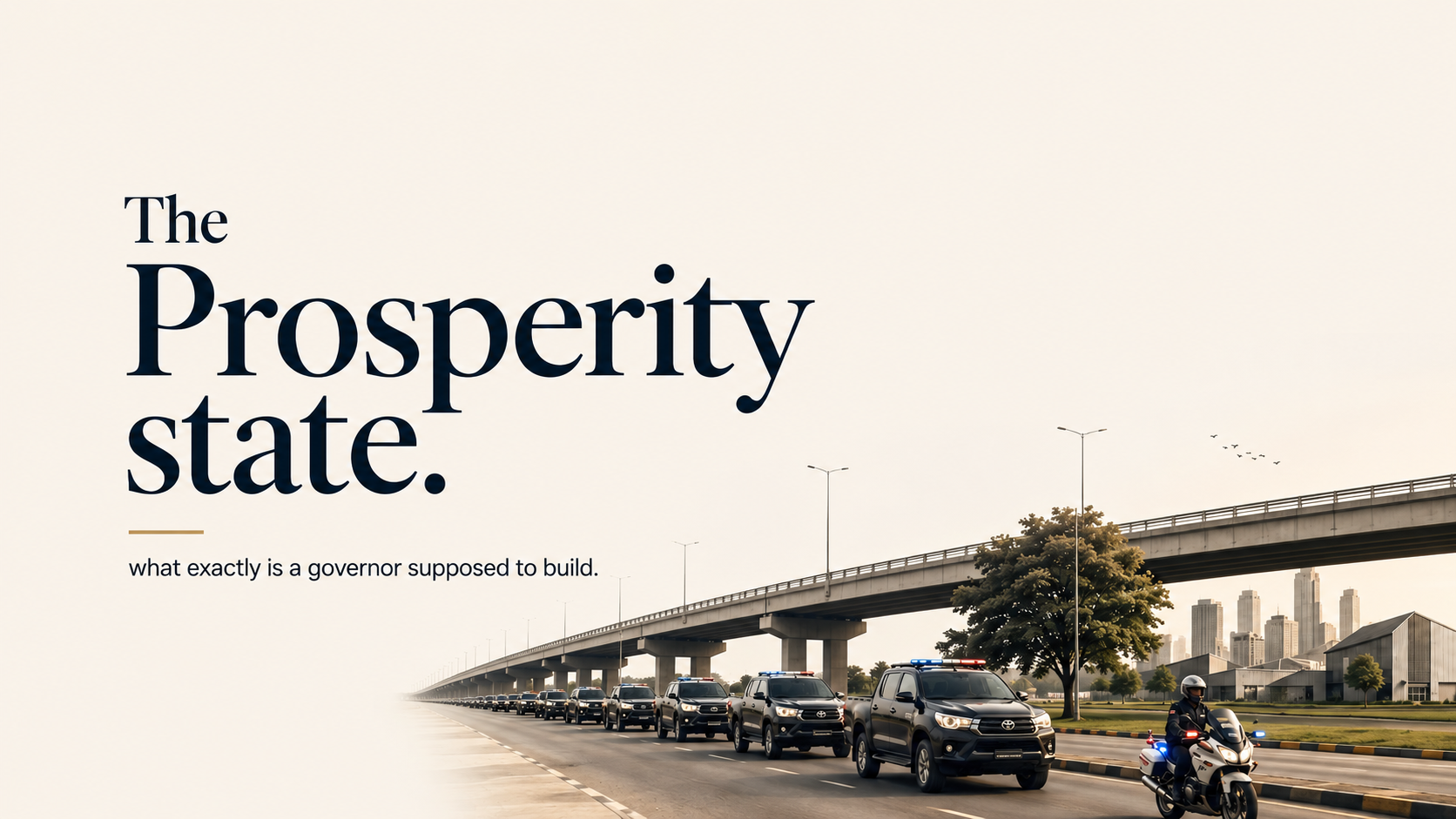
Almost every election season, we judge governors by roads, bridges, flyovers and government buildings. We drive past a new interchange and say, "He's working." We see a shiny secretariat and assume progress has arrived. Somewhere along the way, we accepted that the job of a state government is to build things we can see.
But is that really the job?
It's a question I found myself asking after the recent conversation sparked by President Bola Tinubu's comments about governors and flyovers. The debate quickly became political. Some defended the projects. Others argued they were a waste of money.
I found myself less interested in the politics and more interested in the economics.
Because beneath that argument is a much bigger question.
What is a state government actually supposed to build?
Interestingly, the Nigerian Constitution doesn't begin by talking about roads, bridges or flyovers. In Chapter II, Section 16, under Economic Objectives, it says that "the State shall... harness the resources of the nation and promote national prosperity and an efficient, a dynamic and self-reliant economy." It goes further to say that government should promote "planned and balanced economic development" and ensure that the nation's material resources are harnessed and distributed to serve the common good.
Now, constitutional lawyers will rightly point out that these provisions are found in Chapter II, the Fundamental Objectives and Directive Principles of State Policy. They are intended to guide public policy and governance, even though they are generally not enforceable in court in the same way as fundamental rights.
But they still tell us something important.
The Constitution doesn't simply ask government to construct things. It asks government to build prosperity.
I think that's where we've mixed two different ideas together.
A state can build roads and still remain poor. It can build bridges while unemployment continues to rise. It can commission beautiful projects and still watch its brightest young people leave because there aren't enough productive opportunities.
I'm not saying roads don't matter. They do. Bridges matter too. Every economy needs infrastructure. But if the conversation about development begins and ends with concrete, then we're probably measuring the wrong thing.
Maybe we've been using the wrong scorecard.
Maybe we should spend less time asking, "What did this governor build?" and more time asking, "What productive capacity did this governor leave behind?"
Those are two very different questions.
Take Aba, for example. The city's strength has never primarily come from government-owned factories. It came from generations of shoemakers, leather workers, machine fabricators and traders who gradually built an industrial ecosystem. Think about Nnewi. Its reputation wasn't created by one spectacular government project. It grew because thousands of entrepreneurs, mechanics, manufacturers and spare-parts dealers built businesses that kept creating more businesses. Kano's trading tradition tells a similar story. So do the Local industrial pockets around Ogun and Lagos.
When you look closely, prosperity rarely appears because someone commissioned a project.
It usually grows because people, skills, businesses and institutions keep reinforcing one another over time.
That is why I think Nigerian states should spend more time building institutions alongside projects.
And if I could suggest just one institution that every state should seriously consider, it wouldn't be another technical college.
It would be what I call the Master Craftsmen Programme.
Every state in Nigeria already has extraordinary people quietly building the economy.
The welder fabricating industrial tanks, machinist rebuilding imported equipment that manufacturers thought was beyond repair. The industrial electrician factories depend on, furniture maker whose former apprentices now run workshops of their own, refrigeration technician keeping food processors and cold rooms alive. The diesel mechanic who has become the unofficial engineering department for an entire industrial estate.
These people already exist, the problem is that government hardly knows who they are. Instead of spending billions building entirely new vocational institutions, imagine if every state identified its best master craftsmen through industry associations, local chambers of commerce and most importantly community recommendations.
Imagine certifying them. Upgrading their workshops with better equipment. Helping them improve safety and teaching standards. Then paying them to train apprentices, with success measured not by attendance, but by how many competent craftsmen they produce every year.
That way, young people aren't learning in an environment that has been separated from the real economy. They're learning inside businesses that are already solving real problems, using real equipment, serving real customers and adapting to changing markets every single day.
Government doesn't have to become the teacher. It simply has to strengthen the teachers the economy has already produced. It's also a much faster approach.
A new technical college may take years to plan, build, staff and fully equip. A network of 500 master craftsmen across a state could begin training thousands of apprentices within months. Because the training happens inside productive businesses, the skills are constantly shaped by what the market actually needs.
To me, that feels much closer to what the Constitution had in mind when it spoke about promoting "an efficient, a dynamic and self-reliant economy."
Perhaps this is where the conversation about flyovers should eventually lead us. Not to whether roads matter. They do. Not to whether bridges are necessary. Many are.
But to a much bigger question.
What institutions are we building today that will still be producing skilled people, attracting investment and creating opportunities twenty years after today's governors have left office?
Projects will eventually wear out. Good institutions don't. They keep producing value long after the ribbon-cutting ceremony has been forgotten.
And perhaps, that's the better way to think about development.
Notes
Constitution of the Federal Republic of Nigeria, 1999 (as amended), Chapter II, Section 16 (Economic Objectives). Section 16 directs the State to "harness the resources of the nation and promote national prosperity and an efficient, a dynamic and self-reliant economy." It also requires government to promote "planned and balanced economic development" and ensure that the nation's material resources are harnessed and distributed to serve the common good.
The provisions discussed above are contained in Chapter II – Fundamental Objectives and Directive Principles of State Policy. Under Section 13, these objectives are to guide all organs and authorities of government. However, unlike the fundamental rights in Chapter IV, they are generally treated as guiding principles for governance rather than provisions ordinarily enforceable by citizens in court.