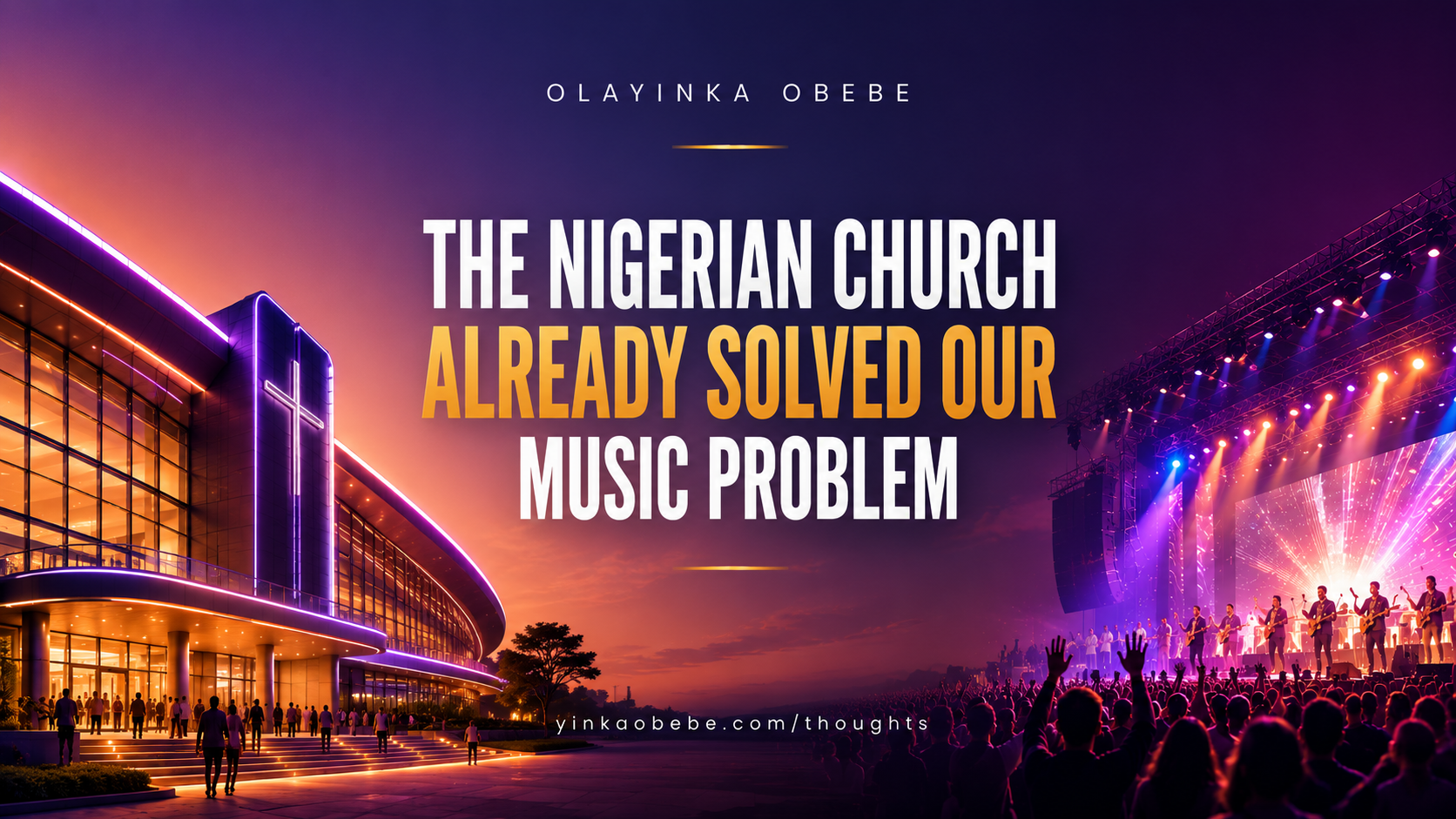
Every Sunday morning, across Nigeria, something extraordinary happens that we have somehow trained ourselves to see only as religion.
Thousands of people arrive at large halls where the sound has already been tested, the LED screens are on and cameras are positioned for broadcast. A band has rehearsed. Backup singers know their parts. Somewhere behind the stage, a music director is watching the entire production while ushers settle the audience, security manages the entrances and parking attendants direct a steady procession of cars.
Then the music starts.
Sometimes twenty people are on stage: drums, keyboards, guitars, horns and layers of voices moving through a carefully arranged performance. The audience knows the songs. They stand, sing, dance and raise their hands. Phones come out. Thirty-second clips are recorded and posted online, and by evening thousands of people who were never in the building have watched parts of the performance.
A few days later, some of these organisations will do it again. By the following Sunday, the entire system resets and thousands return.
We call it church.
But remove the pulpit for a moment and ask an event producer to study the operation. They might describe what they are seeing as venue infrastructure, audience management, recurring live programming, technical production, music development, content distribution and community retention.
Nigerian churches may have accidentally built the infrastructure the Nigerian music industry is missing.
Perhaps we have not noticed because we have spent years looking for music infrastructure in the wrong places.
Nigeria does not have a music talent problem. That argument ended years ago. Burna Boy can stand before tens of thousands of people outside Nigeria. Wizkid sells tickets across continents. Davido announces a tour and audiences thousands of kilometres from Lagos already know the lyrics. Tems walks onto an international stage and the crowd understands exactly who has arrived.
Afrobeats travelled. The producers travelled with it. The fashion, language and even our slangs travelled too.
Yet there is a strange contradiction inside this success. Nigerian music has become globally visible without developing an equally deep live music economy at home.
Outside December, a handful of festivals, clubs, lounges and brand-sponsored events, how often does the average Nigerian buy a ticket simply to watch good Nigerian music performed live?
Doesn’t have to be Burna Boy. Not Davido. Not Wizkid.
Just good live music.
How many 2,000-capacity venues in Ibadan have a proper show every Friday night? Where is the established weekly circuit in Enugu, Benin, Abeokuta, Ilorin, Jos, Uyo or Akure? Could a Nigerian artiste with a loyal but modest audience plan a twenty-city domestic tour today and know that each stop has an established venue, trained production crew, functioning ticketing system and local audience already accustomed to the ritual of attending live music?
We built the stars.
But we did not build the stadiums.
To understand why that is worth our concern, look at American sport.
One of America's greatest commercial achievements in sport is not simply the NBA or the NFL. It is the enormous organised economy that exists underneath them, and nowhere is this more visible than college sport.
On certain Saturdays, entire American towns seem to move towards a stadium to watch students play football. Some of those stadiums hold 50,000 people. Others hold 80,000. A few exceed 100,000.
There are television rights, sponsors, merchandise, food concessions, marching bands and generations of alumni travelling across states. Families wear school colours. Children know the songs. Hotels fill up. Restaurants prepare for game day and local businesses plan their weekend around a fixture published months earlier.
The brilliance of this system is not merely the size of the stadium.
It is the habit.
America understood that the event exists before the superstar.
You do not wait until an athlete becomes LeBron James before teaching people to gather around sport. High school systems, college teams, local rivalries, regular fixtures, stadiums and broadcasting structures create an economy long before its biggest stars emerge. Talent simply moves through a machine that is already waiting for it.
Nigeria's music industry developed in almost the opposite direction.
A young person makes a song in Lagos. It finds its way onto TikTok. Someone in London hears it, a DJ in Paris plays it and streams begin to climb. A record company arrives. The artiste travels. We celebrate another Nigerian global success and immediately begin looking for the next one.
It is a remarkable talent engine, but the domestic machine underneath it remains thin.
Where is the organised weekly circuit that allows an artiste with 200,000 loyal fans to perform across fifteen Nigerian cities? Where does the brilliant band from Jos play every Friday? Where does the alternative singer in Ibadan steadily build a live audience?
And this is not only an artiste problem. A live music economy is also where a young sound engineer works often enough to become exceptional, where a lighting technician moves from competent to world-class, and where a music director learns to manage a 2,000-person show before someone asks them to manage an arena.
This is where the Nigerian church becomes impossible to ignore.
While the commercial music industry searched for its next global star, large Nigerian churches were building halls, investing in sound and screens, developing choirs, bands and music directors, training camera operators and learning how to livestream performances to audiences far beyond the room. Around the stage grew an entire operational system of parking, security, crowd movement, technical crews and recurring programming.
Yet the most important infrastructure they built may not be physical at all.
It is behavioural.
The Nigerian church has mastered the habit of gathering people around live music at least once or twice every week.
Anyone who has ever promoted an event understands how significant that achievement is. The fear behind almost every show is brutally simple: will people come?
The church found its answer in community, frequency, ritual and belonging. Attendance is not reinvented every Sunday. The audience already understands the calendar. The next gathering is expected before the current one ends. New songs can be introduced inside an existing community, young performers can be tested before a live audience and technical teams improve through repetition rather than occasional exposure.
This is not an argument for churches to become nightclubs, pastors to sell backstage passes or the gospel industry to rescue Afrobeats. The comparison is useful because it reveals something we have overlooked about ourselves.
Nigeria does not have a music talent problem. We have not yet industrialised the habit of gathering around live music. But the church has already shown us how to do it.
There is a working Nigerian case study sitting in front of us. We simply classified it only as religion.
Imagine entrepreneurs studying the operational model rather than the theology.
A network of properly equipped music halls across Nigerian cities, perhaps 1,000 to 5,000 seats, designed specifically for live performance. Not giant stadiums and not luxury event centres built primarily for weddings, but halls designed around sound, visibility, crowds and fast production changeovers.
Every Friday and Saturday, the circuit comes alive. An emerging artiste opens for a more established act. A regional star headlines in one city while a mid-tier artiste performs in another. Comedy sits between sets. Food vendors trade outside. Merchandise is sold inside. Sponsors attach themselves to the experience and livestream rights extend the audience beyond the venue.
An artiste might take a four-week residency in Ibadan, performing every Saturday before moving to Benin, Enugu or Abuja. Local charts could begin to measure not only streams but the ability to bring people into a room. Promoters would have calendars rather than isolated events. Audiences would begin to ask a question Nigerians rarely ask outside December: what show are we seeing this weekend?
The same way an American college team knows where it will play next Saturday, a Nigerian artiste should be able to know where the next audience is waiting.
That kind of system changes the economics of music because industries become deep when thousands of people can earn underneath the superstar.
A live show creates work for the sound engineer, session guitarist, backup singer, lighting technician, stage designer, tour manager, security team and photographer. It creates business for ticketing companies, merchandise printers, food vendors, hotels and transport operators moving people and equipment between cities. Local radio has a show to promote. A small sponsor has an audience to reach. A young artiste gets to open for someone with a larger following and perhaps leaves the stage with 500 new fans.
This is what college sport does for American towns. A game is never only a game; an entire local economy moves around it.
Nigerian music can do the same.
A successful song should not only generate streams. It should move people physically out of their homes and into venues, city centres, restaurants, hotels and taxis. Music becomes far more economically valuable when attention turns into movement.
There is another reason the church comparison matters, and perhaps this is the most important one.
Church music does not always wait for a famous person.
A twenty-two-year-old can lead music before 3,000 people because the system gave them a stage. The audience did not necessarily leave home because of that young singer. They came for the gathering and discovered the talent when they arrived.
The audience came for the gathering. Then discovered the talent.
Our commercial music events often work in reverse. We wait for talent to become famous enough to gather an audience and only then organise the event.
American college sport says: build the gathering.
The Nigerian church has spent decades doing exactly that.
Our music industry keeps searching for another superstar.
Perhaps the next phase of Nigerian music is not primarily about finding more stars. We are already frighteningly good at that. It may be about building thousands of stages where talent does not need to become famous before someone is willing to watch.
The irony is that we could spend years travelling to America to study entertainment infrastructure, photographing stadiums and returning with reports about the live events economy. Meanwhile, every Sunday in Lagos, Abuja, Port Harcourt and dozens of Nigerian cities, an organisation opens a large hall, activates professional sound and screens, positions its cameras, brings out a trained band and gathers thousands of people around live music.
Then it does it again the following week.
The Americans built college stadiums.
We built churches.
Maybe we were already closer to the answer than we thought.
We just never looked at the church as infrastructure.