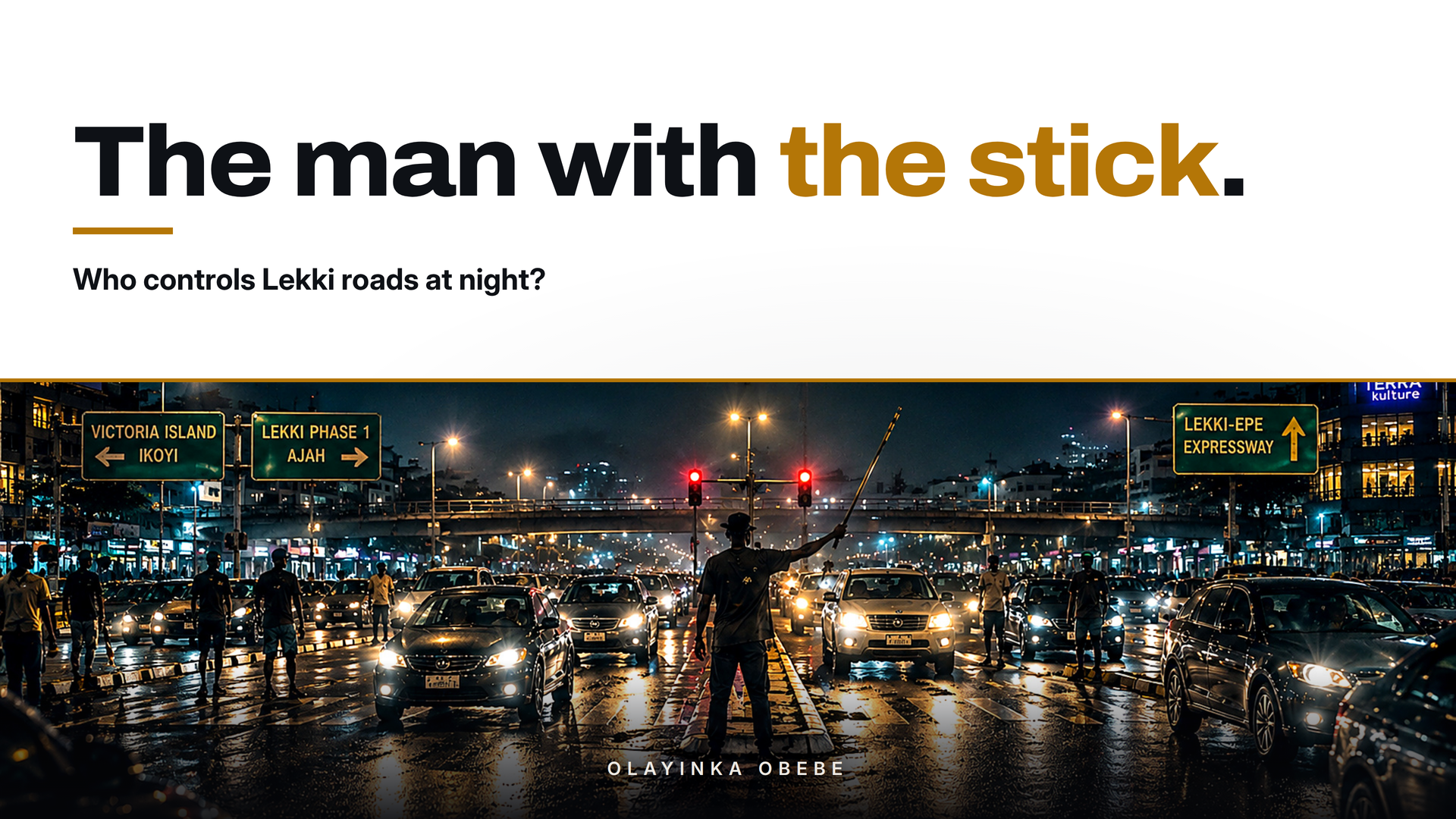
There is something strange about driving through Lekki at night. You can leave Lekki Phase One and head towards Ikota, Ajah, Sangotedo and beyond, and at some point you are likely to find men standing in the middle of the road with large sticks, directing traffic. They are not LASTMA, they are not the police, and they do not appear to belong to any government agency. Yet cars stop when they raise their hands, vehicles move when they wave them forward, and motorists listen to them. Sometimes there is money involved, sometimes intimidation, and sometimes it simply seems to have become an accepted part of how the road works.
There is an interesting complication to this, though. If those men were suddenly removed from some of these junctions, I suspect that some of the junctions would descend into complete chaos. I know this because I have come out of my own vehicle several times about a year ago to try to direct traffic. I have watched motorists refuse to listen to me, try to force their way through and generally behave as though there was no reason they should take instructions from me. On one occasion, I tried to stop a driver and he wound down his window and started abusing me. I had come out of my own truck and asked my driver to position the vehicle so that traffic behind us would not spill into the junction while the other side moved. I was trying to solve an obvious problem, yet the driver did not regard me as somebody with the authority to tell him what to do. I remember thinking that if I had one of those large sticks in my hand, the response would probably have been very different.
That is what makes the situation more interesting than simply asking why area boys are controlling traffic. The stick has become a symbol of authority. The person holding it has no legal authority, but motorists understand that his instruction carries consequences. I can give exactly the same instruction without the stick and be ignored. And when you look at the people sitting inside the vehicles, the paradox becomes even more striking. Many are driving SUVs and expensive cars; some are executive directors, CEOs, founders and senior professionals. These are people who spend their working lives exercising authority, yet at a junction in Lekki they may find themselves taking instructions from a young man standing in the road with a stick. The same motorist who might ignore another citizen trying to organise the traffic can respond immediately to somebody carrying a visible symbol of force. There is something revealing about that.
It is also happening on one of Nigeria's wealthiest neighbourhood stretches. The Lekki axis has become one of the most important areas of Lagos' economic expansion, with expensive residential developments, major businesses, hotels, industrial projects and significant infrastructure concentrated along the corridor. The broader Lekki-Epe axis is part of the economic future Lagos is actively building. Yet on some nights, on some of the same roads through which that future is supposed to pass, the person exercising the most visible authority may be a man with a stick. That contrast should make us uncomfortable, because the issue is no longer simply traffic management. It is what happens when an unofficial system becomes sufficiently established that people begin to treat it as part of the infrastructure.
I began to see another side of this when parts of the road were still badly damaged. Before some of the recent repairs, there were stretches where the potholes on the Lekki-Epe Expressway were so bad that navigating them became a matter of concentration, luck and experience. I personally lost three tyres there. One time, I hit a bad section and lost a tyre, and almost immediately more than twenty people surrounded my car. There was a vulcaniser, there were tyres for sale, people were offering to help, and others were asking for money. Everything seemed to appear around the broken-down vehicle almost instantly. The second time, I lost two tyres on the same side of my car and the impact damaged the shock absorber. Then, right in front of me, I watched a Porsche Panamera lose its tyres, an SUV lose its tyres and a commercial bus lose two tyres. It began to look less like a series of unfortunate incidents and more like an economy that had formed around the failure of the road.
I was told at the time that some of the boys deliberately dug sections of the road and waited for vehicles to fall into them. I cannot independently establish that every pothole I encountered was deliberately created, so I would not present that as fact. But the allegation is disturbing because it points to what can happen when a weakness in public infrastructure becomes a predictable opportunity for private income. The motorist gets stranded, the vulcaniser is nearby, tyres are available, people are waiting to provide assistance and money changes hands. Recent reporting on the Lekki-Epe corridor has also carried allegations from motorists and residents about deliberate obstruction and damage to sections of the road for the purpose of extortion. Whatever the truth of each individual incident, the broader phenomenon is difficult to miss: an informal economy can grow around a public failure.
The same thing happens with the money motorists are sometimes expected to pay simply for passing through. Artists, celebrities, popular figures and other recognisable people have been extorted in these kinds of places. It is easy to say that motorists helped create the system by paying, and there is some truth in that. Once people discover that handing over money makes an uncomfortable encounter disappear, the payment becomes part of the arrangement. But it is also easy to judge the person paying when you are not sitting inside the vehicle. If the people outside already recognise your car, know who you are and know that they can make your journey very uncomfortable, you may decide that giving them money is easier than finding out what happens if you refuse. Over time, people stop thinking of it as an extraordinary situation and start thinking of it as something they simply have to navigate.
That is how these systems become established. The driver pays because he wants to get home. The stranded motorist buys whatever tyre will get him back on the road. The celebrity pays because he does not want trouble. The roadside trader sells because there is a customer. Each decision may make sense to the person making it, but collectively they allow an unofficial system to become part of everyday life. Eventually, people know which junction to be careful around, whom to listen to, what to pay and where to go when something goes wrong.
Government is not unaware of these places. LASTMA knows the major traffic corridors. The police know them. There have been arrests and enforcement operations, and sections of the road have now been repaired. So the question is no longer simply whether government knows that this is happening. The question is why the problem keeps returning. If LASTMA is present during the day and leaves at 10 p.m., only for a junction to descend into disorder by 11 p.m., midnight or one in the morning, then the state has not really established authority there. It has established a daytime presence.
The answer, therefore, cannot simply be another occasional operation in which officials arrive, clear the road, arrest a few people and leave. If these are known hotspots, they need consistent attention, particularly at night. There needs to be enough legitimate enforcement that motorists know who is actually in charge, and there needs to be a way of responding quickly when a junction is blocked, a vehicle breaks down or a road defect creates another opportunity for this informal economy. Most importantly, government has to make the area boys unnecessary. If removing them tomorrow simply causes the junction to collapse into chaos, then the unofficial system has been removed without replacing the function it was performing, however illegitimately.
That is the real test of government authority: not whether it can clear a junction for an afternoon, but whether it can create enough order that people no longer need the man with the stick. The area boy did not create the underlying vacancy. He found it and occupied it. Once people have lived with that long enough, they adapt to it, and that adaptation is what makes the problem harder to see. The city continues to function, but through a collection of informal arrangements that were never supposed to be necessary.
And this is where I start wondering how many other places around Lagos work this way, and how many more exist around Nigeria. How many junctions have their own unofficial traffic managers? How many communities have developed their own systems of settlement, protection and enforcement because the formal system is intermittent? And beyond traffic, where else have we allowed informal authority to fill spaces that should belong to the state, in public transport, street trading, building control, environmental enforcement, public safety and even the protection of businesses and communities? At what point does accommodation become surrender?
The Lekki-Epe corridor is one of the places where we should be able to see the state at its best. It is one of the country's wealthiest neighbourhood stretches, one of Lagos' major growth corridors and a place where businesses, investors, tourists and visitors from outside Nigeria increasingly pass through. This is not about saying poorer neighbourhoods matter less. They do not. Everyone deserves safe roads and protection from extortion. But if we cannot maintain predictable authority on one of the country's most important economic corridors after dark, then what exactly are we saying about the kind of city we are building?
The road may be fixed now. The potholes may be gone. The lights may be working. But if people still believe that the person they really need to listen to at that junction is the man holding the stick, then the deeper problem is still there.
We have repaired the road. We have not necessarily repaired the authority.
And perhaps the bigger question is: where else in Nigeria have we allowed the absence of formal authority to become normal?