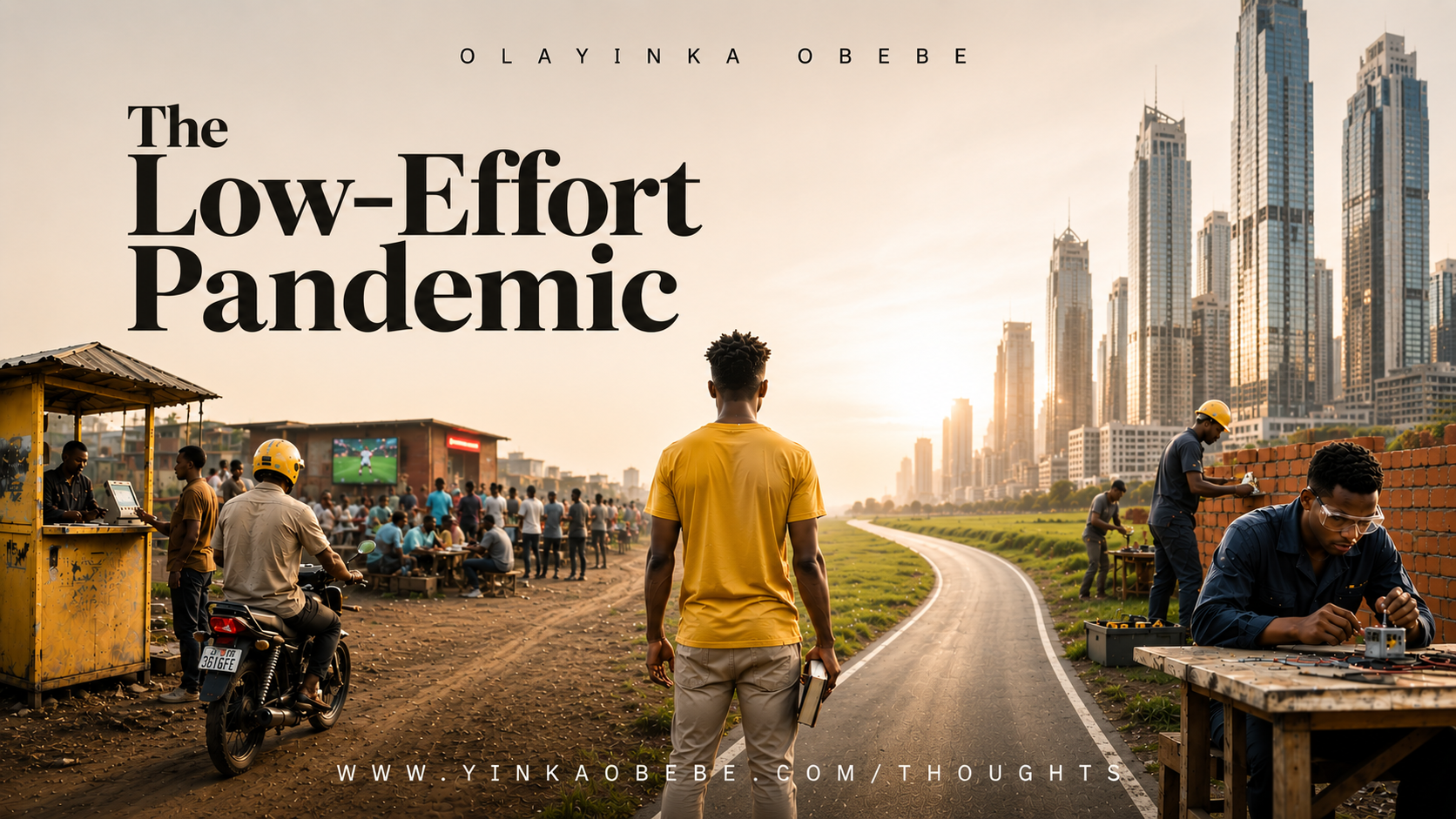
A pandemic is not defined by what it infects. It is defined by how quickly it spreads, how difficult it becomes to resist and how much damage it leaves behind. By that definition, Nigeria is already living through a new kind of pandemic.
It isn't biological.
It's behavioural.
It quietly rewards immediate income over accumulated competence, convincing more people each day that the fastest way to earn is better than the slower, often harder work of becoming genuinely valuable. Like every pandemic, it spreads through imitation. One person finds a shortcut, another copies it, then a hundred more follow until the behaviour becomes normal and eventually invisible.
I call it The Low-Effort Pandemic.
This is not an attack on honest labour. Every legal means of earning a living deserves dignity, especially in a country where survival itself has become a daily struggle. The problem is not that people are working. The problem is that more and more of our economy rewards activities that require very little learning, very little skill development and very little long-term value creation.
Walk through almost any Nigerian neighbourhood today and the pattern begins to reveal itself.
There is a POS kiosk every few metres. Thousands of young men spend their days riding motorcycles or tricycles. Sports betting shops continue to multiply. Social media overflows with promises of quick money. Even prostitution, once hidden in the shadows, has become so normalised in some circles that it has evolved into what many casually call "hookup culture," turning intimacy into another fast-income strategy for many young women.
Each of these activities is different.
Yet they all offer the same promise.
You can start earning almost immediately.
Very little preparation.
Very little apprenticeship.
Very little mastery.
That is how pandemics spread.
Nobody wakes up intending to become part of one. They simply observe what everyone else is doing, compare how quickly money is coming in and make what appears to be the most sensible decision.
One person opens a POS stand.
Ten others follow.
One street has five.
Soon there are fifty.
Before long, nobody even pauses to ask whether the country actually needs another one.
Individually, these decisions make perfect sense.
Collectively, they create a national problem.
The greatest danger is not what people are choosing.
It is what they are no longer choosing.
Ask a plumber whether young people still want to become apprentices.
Ask a bricklayer.
Ask a welder.
Ask a carpenter.
Ask an electrician.
Ask a mechanic.
Many of them will tell you exactly the same story.
"Nobody wants to learn anymore."
That sentence should frighten all of us.
For generations, Nigeria did not rely solely on technical schools to produce skilled workers. Our biggest vocational institution was apprenticeship. Knowledge moved from master to apprentice, from one generation to the next. A young person would spend years learning a trade before eventually opening a workshop, employing others and training another generation. It was a slow system, but it quietly built mechanics who could rebuild engines from scratch, furniture makers whose work lasted decades and electricians whose confidence came from years of practical experience rather than watching online videos.
That chain is breaking.
Why spend four years learning electrical installation when you can begin earning tomorrow on a motorcycle?
Why endure years as an apprentice tailor when a POS machine starts generating income almost immediately?
Why remain under a master craftsman when the culture keeps celebrating the fastest route to cash?
These are not foolish decisions.
They are rational responses to an economy that increasingly rewards speed more than mastery.
The tragedy is that while we celebrate today's income, we are quietly destroying tomorrow's skills.
Artificial intelligence makes this conversation even more urgent.
Around the world, people worry that AI will replace accountants, lawyers, customer service agents, writers and even software developers. Entire industries are preparing for dramatic change.
Ironically, many of the jobs AI struggles to replace are exactly the ones Nigerians are abandoning.
Artificial intelligence cannot repair a leaking roof.
It cannot install electrical wiring in your house.
It cannot lay bricks.
It cannot weld your gate.
It cannot fix a burst water pipe.
It cannot repair your generator.
The world is moving towards a future where skilled technical work may become even more valuable, yet we are steadily convincing our young people that these careers are somehow beneath them.
Now imagine Nigeria fifteen years from today.
The master bricklayer you always relied on is now 72 years old.
The electrician who wired half the houses in your neighbourhood is 69.
The plumber everyone trusts is 67.
The mechanic who can diagnose an engine simply by listening to it is 71.
The carpenter whose work lasts for generations is 74.
You need one of them desperately, but there is nobody in their forties or thirties ready to replace them because, twenty years earlier, too few people chose to learn under them.
That future is not impossible.
In many places, it has already begun.
The irony is almost painful.
We proudly describe ourselves as one of the youngest countries on earth, yet youth alone is not an economic advantage.
An unskilled young population is not an asset.
It is a liability waiting for its invoice.
Nigeria's population is approaching 240 million people, and roughly seventy percent are under the age of thirty-five. That means well over 160 million young Nigerians should become the productive engine of our future. If only a small percentage acquire valuable technical skills while millions drift into low-productivity work simply because it pays faster today, the country is not merely losing jobs. It is quietly surrendering its productive capacity, and the bill for that decision will eventually be measured in trillions of naira.
The solution is not to mock POS operators.
It is not to insult motorcycle riders.
It is certainly not to judge young women driven into transactional relationships by economic desperation.
People respond to incentives.
Always.
If low-skill work pays immediately while apprenticeship demands years of sacrifice with little support, we should not be surprised by the choices people make.
The real question is whether our incentives are producing the society we hope to become.
Perhaps we should begin paying apprentices.
Perhaps vocational education deserves the same prestige we reserve for university degrees.
Perhaps master craftsmen should receive tax incentives for training young people.
Perhaps skilled trades should require respected national certifications that elevate both income and social status.
Perhaps we should finally recognise that the strength of a nation is measured not only by the number of graduates it produces but also by the number of people who can build, repair, manufacture and create.
Every generation leaves something behind for the next.
Roads.
Institutions.
Businesses.
Knowledge.
Skills.
What will our generation leave if everyone is busy chasing the quickest path to today's income while almost nobody is preparing for tomorrow's work?
Every pandemic leaves survivors and casualties.
The casualties of this one may not die, but they may inherit a country that has quietly forgotten how to build, repair, manufacture and create. By then, the virus would have done its work, not by making us poorer overnight, but by convincing an entire generation that becoming useful was less important than becoming busy.