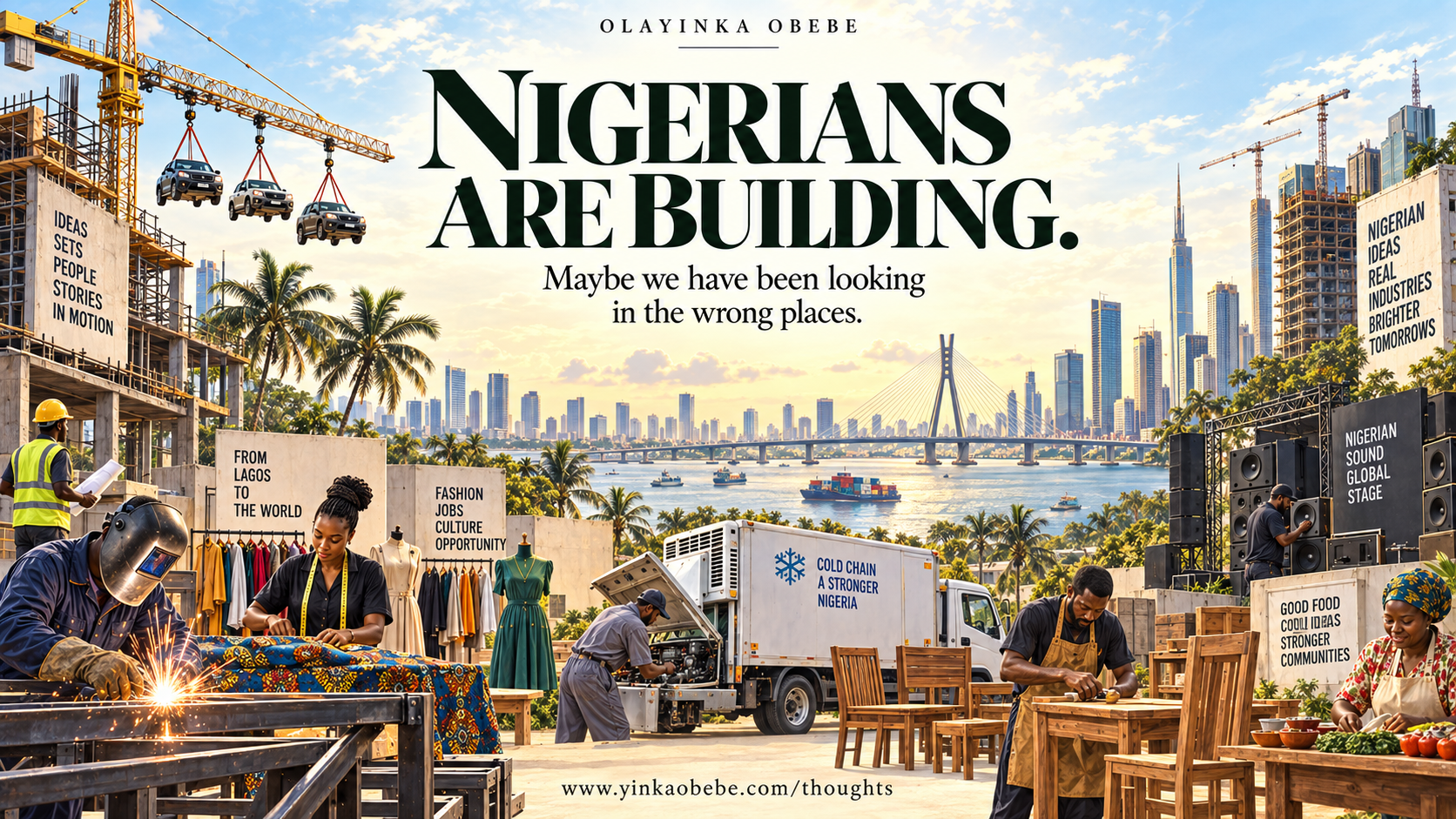
Someone said recently that Nigerians do not build anymore, that we have become a country of influencers rather than makers, and while I understand the frustration behind the statement, I find it difficult to accept because I know people doing the opposite, turning drawings, materials and rough ideas into things that work. Perhaps the problem is not that Nigerians are no longer building, but that much of the building is happening outside the places where we have trained ourselves to look.
Take Rilwan, whom I have worked with for seven years. You might call him a welder, but that description is too small for what I have watched him do, on reality television productions that demanded more than joining metal. We have built levers, pulley systems and mechanical rigs, constructed a water body that held thousands of litres of water for a television show, and even fabricated trusses from which we suspended six cars. These were systems that had to carry weight, move properly and work repeatedly under production conditions. Rilwan builds.
Then there is Mr. Rasheed, whom I first met ten years ago because I wanted him to build a cage for my dogs, and instead we went on to build far more together. He has made well over 250 pieces for me, and when we built out the Popcentral TV studios, along with elaborate television sets that took weeks to complete, he was there making the furniture and environments that gave those spaces their form. Tables, chairs, sofas, sets: what looks effortless on screen begins in a workshop with somebody measuring, cutting and building.
Seun Olawore is another example of how language can reduce capability. You might call him a mechanic, except I have watched Seun build at least three cars almost from scratch, cars that actually drive on Nigerian roads, and now he is applying that instinct to cold-chain logistics vehicles. He is creating what is needed.
My friend Ejiro Amos Tafiri is usually described as a fashion designer, which is true but incomplete, because behind the elegance of fashion sits production and manufacturing discipline. She has built garments that have sold in their tens of thousands, collected multiple awards and taken her work to international runways, all of which rests on somebody cutting, sewing, finishing and delivering every piece. We call it fashion, but there is industrial capability underneath it.
One of my favourite discoveries happened while I was eating amala and ewedu at Iya Yusuf in Bodija, Ibadan. The doors were open, there was no conventional air-conditioning, yet the room was surprisingly cool because of a locally built machine moving cooled air through the space. I called the phone number on the machine, found the man who built it, and brought him to Lagos to build two for me. If you are in Lekki, Lagos, you can come to Popcentral Culture Space and see them yourself.
Then there is Kunle Akintayo, who does not merely import or sell speakers but designs and builds them, and some of the speakers he has made are among the best I have listened to. Once you put these people together, the question changes. It is no longer whether Nigerians can build; clearly they can. The harder question is why so few of these capabilities become industries.
I do not think Nigeria has a shortage of builders. I think we have builders everywhere, but too few pathways from builder to industry, from workshop to scale, from individual competence to national capability. What I see is an industrial country hiding in plain sight and finally taken seriously.