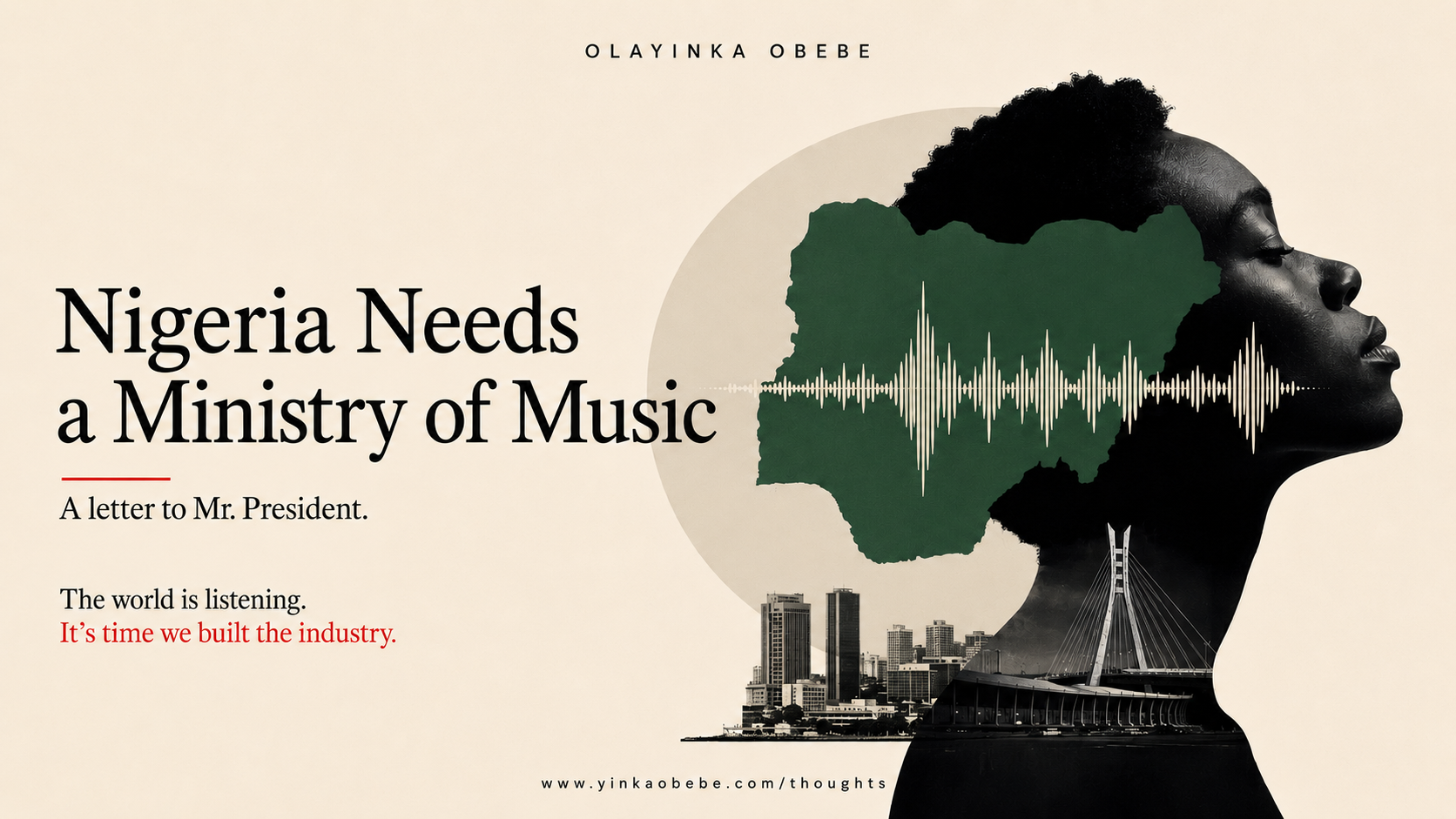
Mr. President,
I know that is a strong way to open a letter, but stay with me, because this is a thought that has been on my mind for a while about what countries do when they discover they are really good at something, because sometimes it is technology, sometimes it is manufacturing, sometimes it is something nobody planned for, and then something changes and that thing stops being an accident and becomes something the country decides to build around.
I think we may be at that point with music.
Our music has gone further than most of us ever expected, and when you consider how little of this was centrally planned, how much of it was built by artists, producers, labels, promoters and entrepreneurs simply finding their way, it becomes even more interesting, because the world has somehow decided that something coming out of Nigeria is worth listening to.
Before anything else, let me say this: I am not taking a swing at the current Federal Ministry of Art, Culture, Tourism and the Creative Economy, because if anything, when you look at everything on its plate, you almost wonder how it manages to give enough attention to any one part of it.
Tourism, heritage, museums, festivals, film, television, fashion, publishing, design, gaming, architecture, performing arts, advertising, photography, and somewhere in that very long list, music.
That is why I started wondering whether music has now grown into something that deserves a different kind of focus, because there is only so much attention one ministry can give to so many different industries, particularly when each one of those industries has its own problems, opportunities, economics and infrastructure.
The Federal Government itself has spoken about building Nigeria’s creative economy into a $100 billion industry and creating millions of jobs from it, and music is expected to be one of the important parts of that ambition. Once numbers like that enter the conversation, I start asking business questions, because if music is going to contribute meaningfully to an economy of that size, where exactly does the money come from, where do the jobs come from, what businesses have to exist that do not exist today, what infrastructure needs to be built, and who is sitting somewhere every morning thinking about all of this as one connected industry?
Those jobs cannot all be artists, because they will also be managers, lawyers, producers, engineers, promoters, venue operators, tour managers, publishers, accountants, technicians, software developers, investors and businesses we probably cannot name today because nobody has built them yet, and when you begin to look at music that way, it becomes difficult to see it simply as one item sitting somewhere inside a very long creative-industry list.
I keep coming back to focus.
When I look at South Korea, most people see K-pop, but I find myself looking at everything that grew around it, the companies, training, television, export machinery, tourism, technology, private capital and an entire commercial system that understood that Korean culture could travel and built around that possibility.
China offers an even bigger example from a completely different industry, because we see the electric cars now, we see the batteries, the solar panels and increasingly sophisticated technology, but behind what we see today were years of concentration, investment, infrastructure, manufacturing capability, supply chains, incentives, research and deliberate decisions about industries in which the country intended to compete.
I wonder what that kind of concentration would look like if Nigeria applied it to music.
And this is not an Afrobeats conversation, because it is Fuji, Gospel, Highlife, Juju, Hip-hop, Apala, traditional music and everything else happening across this enormous country, including the music economies that already exist around weddings, naming ceremonies, churches, festivals, parties and communities and which may never appear on a Spotify chart but nevertheless employ people and move money every weekend.
What happens if somebody actually maps all of that, and begins to understand not only where the music is being made, but where money is already going, where livelihoods are already being created, where opportunities are being lost and where relatively small interventions could open up completely new markets?
What could we do across 774 local governments, not necessarily building some enormous concert hall everywhere, but understanding what musicians and music businesses need at that level, where people rehearse, where they perform, how talent develops, how local sounds are preserved and how somebody living hundreds of kilometres from Lagos enters the music economy?
Then there are 36 states, and another level of thinking becomes possible around touring, venues, festivals, training, investment and infrastructure, while nationally we can begin dealing properly with copyright, publishing, financing, data, exports, technology, international touring and the things that require coordination at scale.
That is the kind of institution I am talking about.
If we ran this like a business and suddenly discovered that one part of the company was showing extraordinary potential around the world, we would probably build a serious team around it, give that team targets, give it resources, remove roadblocks and ask what that part of the business could become in five years, and I am not sure countries should think very differently when they discover an advantage that has the potential to create jobs, businesses, exports and influence on this kind of scale.
So perhaps it is a Ministry of Music, perhaps it eventually makes more sense as a commission or an authority, but I am less concerned about what is written on the signboard than I am about whether we can put together a group of people whose entire responsibility is music, who are not also thinking about tourism, film, fashion, museums, gaming and everything else, and who can spend the next five years trying to understand just how large this thing can become.
Give those people the ability to work across the Federal Government, states and local governments, and let them sit with artists, investors, technology companies, universities, venues, labels, publishers, traditional musicians and everybody else who forms part of this economy, because the first thing we may discover is that what we casually call the music industry is actually several different industries sitting beside and on top of one another, some formal, some informal, some already global and others still almost completely invisible.
And then give them numbers to work towards, because five years from now we should be able to ask how many jobs have been created, how much investment has entered the industry, how much export revenue is coming from Nigerian music, how many cities can support a proper touring circuit, how much more money is being collected by the people who own the rights, how much of our traditional music has been documented and preserved, how many serious music businesses have been created, and what exists in the Nigerian music economy in 2031 that simply did not exist when we started.
That, for me, is where the $100 billion creative-economy ambition becomes particularly interesting, because once we have decided that the creative economy can become that consequential to Nigeria, then surely it is worth asking how large music itself could become if somebody was given the responsibility of finding out, particularly when we are starting with something that has already demonstrated that it can travel beyond our borders.
Mr. President, countries do not get an unlimited number of opportunities to discover something that the rest of the world genuinely wants from them, and perhaps one of the things history teaches us, whether we are looking at Korean popular culture or China’s extraordinary concentration around industries it decided could matter to its future, is that discovering an advantage is only the beginning; what happens afterwards depends on how deliberately you decide to build around it.
We already have the music, we already have the people, we already have evidence that something coming from here can command attention far beyond Nigeria, and what I am asking is whether this is the moment to stop allowing all of that to develop largely by itself and give some of our best people one very specific assignment for the next five years: take Nigerian music seriously as an industry, understand everything that sits around it, connect what needs to be connected, build what needs to be built, and find out just how far this thing can go.