Every couple of weeks, the country returns to the same uneasy conversations. One day it is insecurity. Another day it is unemployment. Then suddenly everybody is talking about internet fraud, social disorder, broken education or young people who seem somehow disconnected from structure and direction.
We often discuss these things separately, as though they are from different worlds.
But I am increasingly suspecting that many of them are connected by one thing:
Nigeria is still dangerously under-industrialized for a country of this size. And this is not just from an economic standpoint.
When I say industrialization, I do not simply mean steel plants, cements, refineries or giant manufacturing complexes. Those are a big deal, of course. But I am also talking about industrializing ordinary everyday businesses at massive scale.
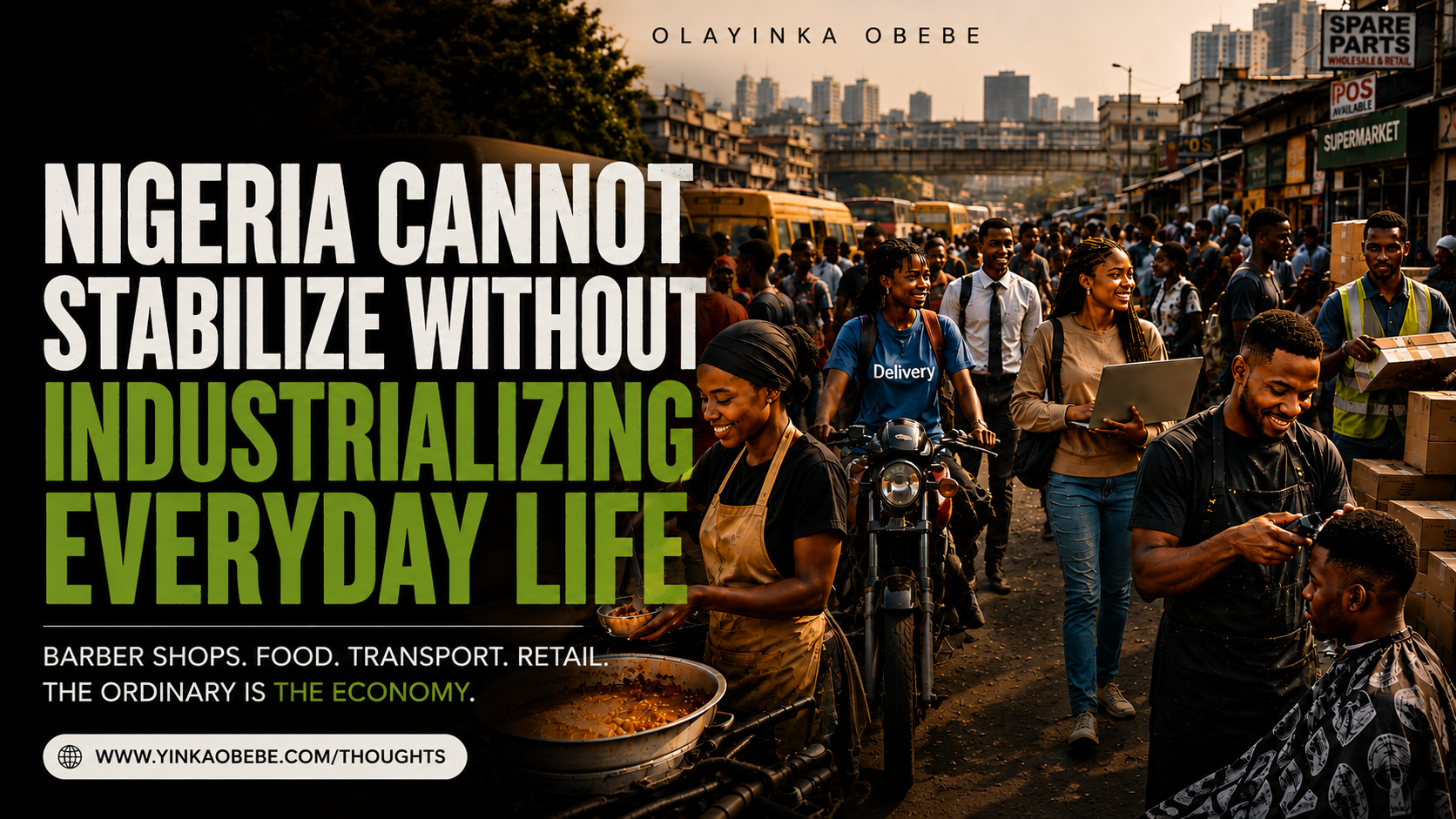
The kinds of businesses Nigerians already spend money on daily without thinking twice about them. Car washes. Restaurants. Spare parts ecosystems. Barbing salons. Cleaning services. Food chains. Supermarkets. Mechanic villages.
One of the biggest questions hanging over this country right now is simple:
What exactly becomes of a nation where almost 70 percent of the population is under 30?
That is not just a random demographic statistic. It is a massive wave of humans moving through society at the same time.
And human beings do not simply need money. They need systems. Routine. Direction. Identity. Progression. Belonging.
A country this large cannot leave millions of young people floating endlessly between disconnected hustle, survival jobs and informal economic activity without eventually paying a social price for it.
And I think we are already paying that price.
Under-industrialization will not only weaken the economy. It weakens social order itself.
A heavily industrialized society deliberately organizes people. It absorbs them into systems. It trains them. It creates accountability, hierarchy and professional culture. It exposes people to standards and repetition. Their entire behavior will slowly begin to change around those systems.
A young man working inside a properly scaled nationwide automotive company develops in a different way from somebody surviving randomly from one roadside opportunity to another every day. A properly organized restaurant chain teaches process different from a struggling one-shop business constantly fighting to stay alive. A nationwide car wash network develops operational culture unlike the scattered roadside washing points operating independently without structure.
And this is where I think we may be misunderstanding industrialization itself.
We keep imagining that industrialization must arrive looking dramatic and futuristic, while we ignore the massive fragmented industries already sitting in front of us.
Meanwhile, many powerful economies deliberately built enormous systems around ordinary life.
America industrialized things as basic as waste management, car washing, uniforms, fitness, grooming and spare parts. and the moment those industries scaled properly, they became more than businesses. They became institutions.
That fact, is more important than we realize.
Large operational companies do something that Nigeria desperately needs right now: they absorb human beings into organized activity at scale. At Scale.
An Idle population shall eventually drift toward whatever structure is available around them. Sometimes that structure becomes productive. Sometimes it becomes destructive.
Which is why I believe industrialization may actually be one of the fastest ways to stabilize Nigeria socially within the next one or two years. Not only economically. Socially.
Once our industries scale, they will begin demanding systems naturally. Documentation, training, and coordination will improve. Advanced purpose built software become indispensable. Regional operations will emerge. Quality control has no choice but to become necessary. Our everyday businesses will stop acting like isolated survival units and slowly begin to represent infrastructure.
Take a place like Owode Onirin.
An entire ecosystem already exists there around dismantling and repurposing vehicles, the skills are already there. Knowledge and demand already exists there.
Is someone asking me if Nigeria can build industries?
The important question is if we can organize what is already alive.
How do you make it cleaner? Safer? More efficient? More scalable?
Sometimes the answer is not creating entirely new industries from scratch.
The answer in crucial times is industrializing the systems Nigerians already built informally.
And it is important to state that this is not an argument against entrepreneurship. Nigeria will always need entrepreneurs. But we also need large operational systems capable of absorbing millions of people into coordinated economic activity.
Right now, too many businesses remain trapped at survival scale. A barber opens beside another barber. Another roadside food spot appears beside three others already struggling. Everybody is operating individually. Nobody has what it takes to scale deeply enough. Nobody can build systems that are deeply enough. Nobody is growing large enough to transform the sector itself.
Meanwhile, in other countries, those same ordinary sectors evolved into industries employing thousands of people across logistics, engineering, operations, customer management, software, inventory systems and regional administration.
And no, let's not interpret this as blindly copying America.
Nigeria must build systems that reflect Nigerian realities.
But Nigerians are not a daft people. So we can, if enabled.
We already have the market activity and population. We have the demand. What we do not have is organized scale.
And I think scale may be one of the missing links between Nigeria’s energy and Nigeria’s stability.
Remember that direction is often created by structure not by randomness.
A young person entering a mature industrial ecosystem can see how professionalism works. How operations and accountability works. He can see how growth works. That exposure penetrates slowly across society.
The next question: who actually builds these kinds of companies? What kind of system does this.
They will not emerge accidentally.
Building these kinds of companies will require serious operators, long-term capital, patience and coordination. It will also demand consortiums, family offices, institutional investors and sovereign funds willing to take ordinary sectors that Nigerians already consume heavily every day far more seriously.
Not only banks, oil or telecoms.
Imagine serious research beginning around restaurant chains, car wash networks, mechanic ecosystems, waste systems or food distribution at scale. Then imagine operators acquiring smaller businesses, merging fragmented systems and building regional or national operational structures around them.
In truth, some of these sectors are already profitable. They are just too fragmented to be strong and scale properly.
Government also has a role here, even if government is not directly funding the businesses themselves.
Government can identify these sectors as national development priorities. Government can encourage consolidation, create financing incentives, support standardization and actively call for the kinds of operators capable of building systems at this scale.
If we ( Nigeria) aggressively industrializes everyday sectors over the next one or two years, I believe the effects will begin showing surprisingly quickly.
Not in theory. This will be in real life.
Structured employment will expand in ways ordinary people can actually feel in their daily lives. Operational culture will slowly be strengthened as businesses begin demanding consistency, training and accountability from the people inside them. Cities/States themselves may start acting in a different way, of course not perfectly, but with more coordination, more order and a stronger sense that systems are actually functioning around people instead of collapsing beneath them. Professional development will become entrenched naturally because the workers exposed to organized environments tend to carry those standards forward into other parts of society.
And perhaps most importantly, millions of young Nigerians will gradually find themselves pulled into functioning systems instead of drifting endlessly between instability, uncertainty and survival-mode living.
That kind of shift will create changes more than income levels.
It changes psychology. It repositions expectations. It helps how people reimagine their future and their place inside society.
And once that begins to happen at scale, industrialization will stop being just an economic conversation.
It becomes part of how a society actively learns to organize itself.