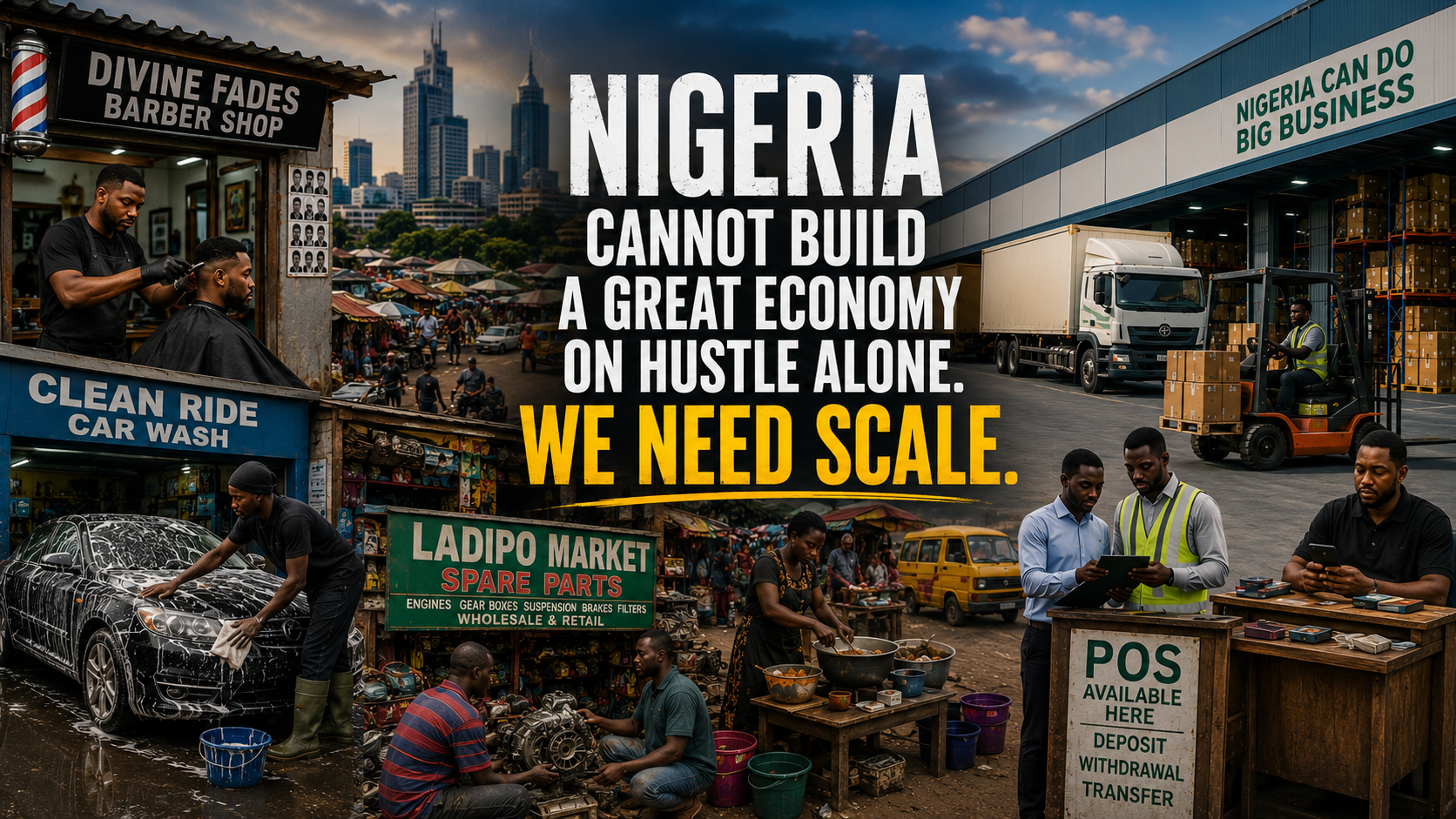
One thing I keep thinking about lately is how much Nigeria celebrates hustle culture, even when the hustle itself is struggling to breathe.
We praise survival so much that we hardly stop and ask whether survival is the same thing as development.
Everywhere you turn in Nigeria, people are working. Somebody is opening a barber shop. Another one starting a car wash. Someone is beginning a logistics business with one bus. The energy is incredible.
But after a while, you begin to notice something uncomfortable. Many of these businesses remain permanently fragile. One bad month, a rent increase, maybe a diesel price jump, or minor staff issues, and the entire operation has already started shaking.
Yet we still expect world-class service from businesses operating under that kind of pressure.
In Nigerian, we complain endlessly about customer service, inconsistency and lack of professionalism. But many of these businesses are simply too small and undercapitalized to consistently deliver what we expect from them.
Again, in Nigeria, we think that fragmentation means freedom. Everybody can open their own small business. Everybody can “be their own boss.”
But freedom is not a business that is hardly breathing. That is not what being free looks like.
A struggling one-shop operation trying to survive inflation, fuel costs and unstable power supply will perpetually struggle to build systems, continuity and dependable service.
That is simply the reality.
Over the last few weeks, I have been studying some ordinary businesses in America that became giant companies. They are not part of the glamorous companies. These are not the usual suspect tech or AI companies. They are everyday businesses.
One company was built around spare parts and it became worth over 60 billion dollars. Another was built around garbage collection and it is now worth over 100 billion dollars. There are other companies built around uniforms, industrial supplies and washing dirty towels that quietly became massive institutions.
And what struck me was how ordinary the businesses actually were.
The difference was scale.
America did not stop at hustle level. They took everyday industries and expanded them aggressively. They standardized operations, raised capital, built systems and created companies large enough to survive shocks and maintain consistency.
Then many of those companies became publicly traded, allowing ordinary citizens to buy shares and participate in the growth of those industries.
Imagine what that changes.
A larger, stronger company can train staff properly. It can build operational culture. It can document systems. It can negotiate financing more effectively. It can create continuity that will survive beyond one owner’s daily energy and vision.
Even workers will benefit better inside stronger institutions. Pension systems will become easier to sustain. Health insurance will be more realistic. Skills become transferable. The standards will become easier to replicate.
Meanwhile, Nigeria remains heavily fragmented across many everyday industries. Too many sectors still operate almost entirely at survival scale.
And anytime conversations about building larger companies come up, people quickly start shouting “monopoly.”
Nigeria has become emotionally suspicious of scale itself.
But building a large company is not automatically monopoly. Building a moat around a business is not evil. Creating a company strong enough to survive, expand, repay loans safely and employ thousands of people consistently is not oppression.
Sometimes it is exactly what development should look like. Once it works, another capital will establish a competition at scale, often bigger.
Now, somebody may argue that in America and other developed countries, people can still become their own boss more easily and even raise funding faster.
That is true.
How many banks do you see randomly funding small businesses properly here and why are they not?
And even the biggest funding stories abroad are often attached to breakthrough technology, major inventions or genuinely exceptional products. All of that also sits on top of an already standardized commercial environment built around strong, organized and well-capitalized companies.
That foundation is everything.
In Nigeria, we are trying to leap into advanced entrepreneurship while many everyday sectors are still operating without deep structure.
There is also this romantic idea that everybody must become a small business owner. But honestly, many Nigerians would likely live more stable and prosperous lives working within stronger companies with training, structure, growth paths and dependable salaries.
It is not likely that an economy will become powerful through millions of tiny unstable businesses.
Strong economies are usually built when everyday industries mature into institutions.
And Nigeria already has the raw material for this transformation.
We are energetic people. Commercial people. Nigerians know how to trade, negotiate, adapt and build. The country is alive with economic activity. What we often lack is scale, structure, patient financing and institutional ambition.
I sometimes think we spend too much time dreaming about becoming a subsidized Gulf-style economy instead of leaning into the fact that Nigeria is naturally a commercial society.
This country is not asleep.
It is under-organized.
Imagine what happens if we begin intentionally industrializing everyday sectors like logistics, waste management, repairs, maintenance and distribution.
Imagine what happens when those businesses become properly financed national companies with systems, standards and expansion plans.
Employment will improve. Service quality will get predictable. Training will improve. Pension systems will start making sense. Insurance will become more realistic. The middle class will begin to stablize.
The government needs to think of ways to make this attractive to consortiums, the effect of it’s success will solve so many problems at one go, especially where we think the issues are cultural. We don’t have inherent problems because we are Africans or black, we are not cursed, we are very okay, some of the best humans on earth, we just need to be organised.
A country starts changing when the ordinary industries stop operating like temporary hustle and they start evolving into dependable institutions.
And maybe that is one of the biggest economic transitions Nigeria still needs to make.