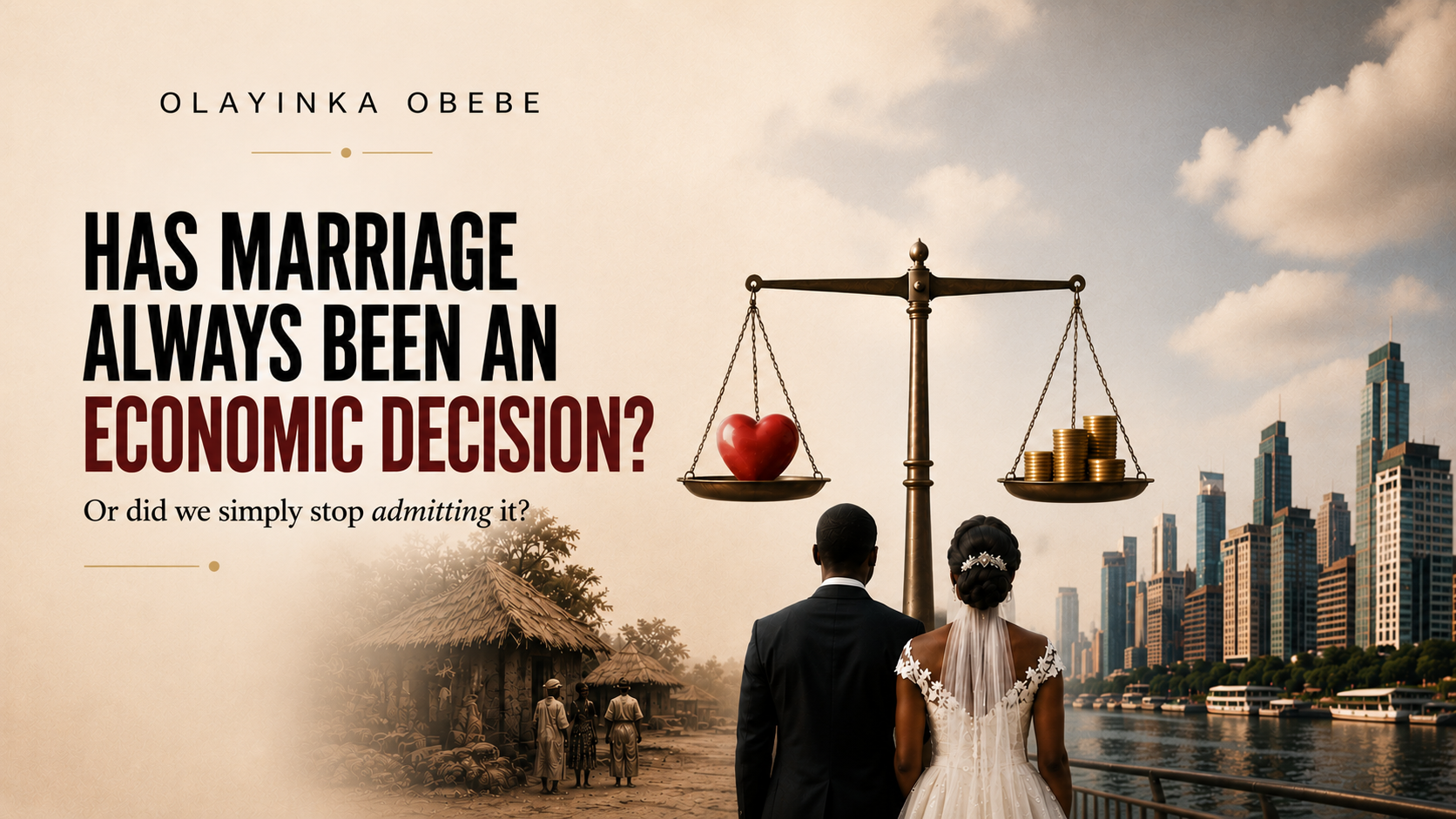
Every few months, the sentiment surfaces on a podcast, ripples across social media, or is whispered at a wedding after a few too many glasses of champagne. The diagnosis is almost always the same: "Marriage has become too transactional," or "People don"t marry for love anymore." These statements are often delivered as a lament for a precious, lost ideal, implying that while previous generations married for pure affection, our modern society has become uniquely obsessed with money, status, and financial security.
Whenever I hear these claims, I find myself wondering when exactly marriage was ever not an economic decision. If we are being honest, the idea that marriage was once entirely about love may be one of the most successful stories humanity has ever told itself. This isn"t because love is not real, but because marriage and love have never quite been the same thing; for most of human history, they weren"t even solving the same problem. While love was concerned with emotion, marriage was fundamentally about survival, and survival has always been an economic conversation.
Think about your grandparents or great-grandparents, not the polished Instagram versions of them, but the actual people who lived through uncertainty and raised large families. They farmed land, survived civil wars, and navigated life. When they married, they weren"t just cultivating a romantic relationship; they were building a household that functioned as a unit of production, a support system, and a comprehensive insurance policy. In their world, marriage was a partnership that doubled as a retirement plan and a child-rearing institution all at once.
The modern world often forgets how economically vital these family structures were before the advent of formal systems. Before pensions, your children were your security; before health insurance, your family was your safety net; and before social welfare or nursing homes in western countries, your household was your only protection against the elements of life. Marriage was never simply about companionship; it was one of society"s most essential economic pillars.
This practical reality is exactly why marriage negotiations existed almost everywhere in various forms, from bride prices in Africa and dowries in Europe to livestock transfers and inheritance agreements. These societies weren"t being cynical; they were being practical. Two families weren"t just celebrating a relationship; they were reorganizing resources, creating new obligations, and determining the future of inheritance. They were doing economics, they just didn"t call it that.
In many Nigerian communities, older generations still understand this instinctively, which is evident in the questions families ask when a match is proposed. Inquiries about a person"s family, their career, their responsibility, and their character may sound like social vetting, but underneath, they are economic assessments. Responsibility and stability are economic traits, as is the ability to raise children or withstand hardship. They are not conducting cold job interviews; they are trying to discern if a future household has the capacity to survive.
What has truly changed is not that economics entered marriage, it was always there but that we now have more choices. A century ago, the economic realities were visible through cattle, farmland, and crop yields. Today, those same calculations are hidden behind discussions about careers, earning potential, and financial discipline. The language has evolved to fit a modern lifestyle, but the underlying calculation remains very consistent.
The biggest shift occurred when individuals became less dependent on their families for literal survival. As economies modernized and women gained access to education and income, governments and banks assumed many of the functions that families once carried alone. For the first time in history, large numbers of people could afford to move personal fulfillment to the center of the marital decision. This is where the modern love story originated, love was not recently invented, people just finally gained the freedom to prioritize it.
Yet even now, economics refuses to leave the room. Whether it"s a couple in Lagos, London, Abuja, or New York, the desire for love is inextricably tied to thoughts of rent, school fees, healthcare, and career ambitions. None of these concerns cancel out love, but they serve as a reminder that marriage does not exist outside reality. Love may be the catalyst that brings two people together, but the household they build still requires resources to function.
This intersection is likely why these conversations become so emotional; when we acknowledge marriage as an economic decision, people often mistakenly hear that "love doesn"t matter." However, the reality is more nuanced. Marriage has always been both emotional and economic. Different generations have simply weighted those factors in different ways: some prioritized survival and hoped love would grow, while others prioritize love and hope survival follows. Both approaches carry their own risks and trade-offs.
Perhaps the better question is not whether marriage has become economic, but why we became so uncomfortable admitting that it always was. Once we strip away the social media arguments and the romance, the simple truth remains: marriage has never been just about two people. It has always been about building a life, and building a life has always involved economics. The only thing that truly changes from one generation to the next is how openly we are willing to say so.