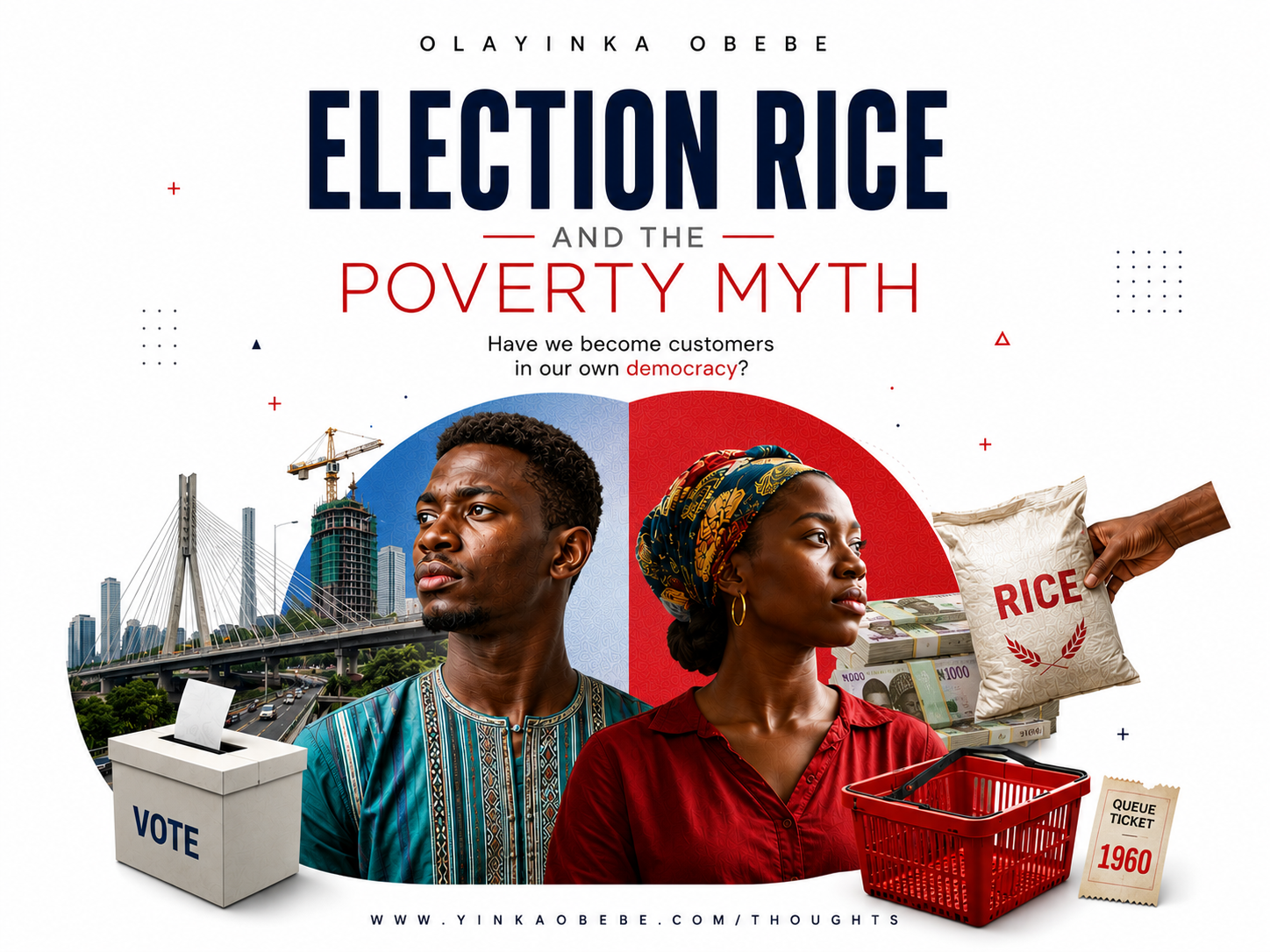
Every election cycle, a familiar explanation emerges.
Politicians distribute rice, noodles, cash and other gifts because voters are poor. Voters accept them because poverty leaves them with no choice.
The story is neat. It is intuitive. But it is also incomplete.
The problem with many explanations of vote-buying in Nigeria is that they begin and end with economics. Yet some of the most revealing clues may lie elsewhere in culture, psychology and the unwritten rules that govern how people relate to opportunity.
Consider a scene that has nothing to do with politics.
At a wedding reception, when souvenirs are announced. Suddenly, the guests who arrived in expensive cars and outfits begin competing for items they could easily afford to buy themselves. Some take one. Others take several. Nobody would describe these people as destitute. Yet the instinct to acquire is unmistakable.
The same pattern appears in countless settings across Nigerian life. Whenever something is being distributed, people often feel compelled to participate in the distribution.
That observation raises an uncomfortable possibility.
What if election rice is not simply a poverty story?
What if it is part of a much larger social habit?
The conventional narrative assumes a direct transaction: politician offers gift, and voter sell their vote. Yet the reality is frequently messier. Many Nigerians have seen people collect campaign gifts and then vote however they wish. If the gift guaranteed loyalty, this would not happen.
This suggests that the exchange may not be as straightforward as outsiders assume.
For many voters, the gift is not necessarily viewed as payment for political obedience. It is viewed as compensation for engagement. A politician wants attention, attendance, participation and visibility. The voter asks a simple question: what is in it for me?
That is a distinction reality.
A person selling a vote and a person demanding an immediate return for political participation are not necessarily engaging in the same behavior, even if they appear similar from a distance.
The difference becomes clearer when viewed through the lens of scarcity.
For generations, many Nigerians have lived in environments where opportunities arrive unpredictably and disappear just as quickly. Access to resources is often inconsistent. The lesson learned from such environments is rarely philosophical. It is practical.
When something becomes available, secure it.
This way of thinking can survive long after the original scarcity conditions that produced it.
People usually stop evaluating opportunities according to need and begin evaluating them according to availability. The question shifts from "Do I require this?" to "Can I obtain this?"
In societies shaped by uncertainty, acquisition itself becomes a rational response.
There is another factor at work: the fear of being left behind.
Many people have witnessed situations where those who hesitated received nothing while others walked away with more than their share. Under such conditions, restraint can feel less like virtue and more like vulnerability and stupidity.
That individual who declines an opportunity is not always admired. Sometimes he is regarded as naive- a fool.
Over time, this produces what might be called an extraction mindset.
Extraction is not the same as theft. Nor is it identical to corruption. It is a way of seeing the world.
Whenever value appears, the instinct is to secure a portion of it before it disappears.
The mindset reveals itself in everyday language. Nigerians frequently speak of "collecting their own." The phrase is revealing because it frames opportunity as something to be claimed rather than something to be created.
This brings us to one of the most important distinctions in economic life: the difference between wealth creation and wealth capture.
Productive societies tend to celebrate the expansion of value. The entrepreneur asks how to build, innovate and create. The goal is to enlarge the pie.
Extraction-oriented environments encourage a different calculation. The focus shifts toward securing a share of value that already exists. The objective becomes access rather than expansion.
Neither impulse is unique to Nigeria. Every society contains both. The question is which one becomes dominant.
When extraction becomes the prevailing instinct, politics inevitably changes.
Public office now looks less like a platform for governance and more like a distribution mechanism. Citizens become less interested in long-term policy outcomes and more interested in immediate returns. Elections now transform from contests of ideas into competitions between rival networks of allocation.
At that point, the conversation is no longer merely about poverty.
It is about citizenship.
Healthy democracies depend on citizens who see themselves as stakeholders in a collective project. Stakeholders evaluate leadership according to future outcomes. They ask what policies will strengthen institutions, expand prosperity and improve national performance over time.
Customers ask a different question.
What am I getting today?
The distinction may seem subtle, but its consequences are profound.
A society of stakeholders tends to reward competence. A society of customers tends to reward distribution.
This is why the debate over election rice cannot be reduced to hunger alone.
Poverty undoubtedly influences political behavior. To deny that would be absurd. Economic hardship remains one of the most powerful forces shaping democratic participation across the developing world.
But poverty does not explain everything.
It does not explain why people who are financially comfortable often display the same instinct to acquire whatever is being distributed. It does not explain why some voters accept gifts without feeling any obligation to reciprocate politically. And it does not explain why the language of entitlement and extraction extends far beyond elections into everyday life.
Perhaps the most revealing question is not why people collect election rice.
The more revealing question is why so many forms of public life in Nigeria are experienced as distribution events.
Until that question is confronted, discussions about vote-buying will continue to focus on symptoms while missing the deeper forces beneath them.
The bag of rice may be real.
But the mindset that gives it power is far larger.