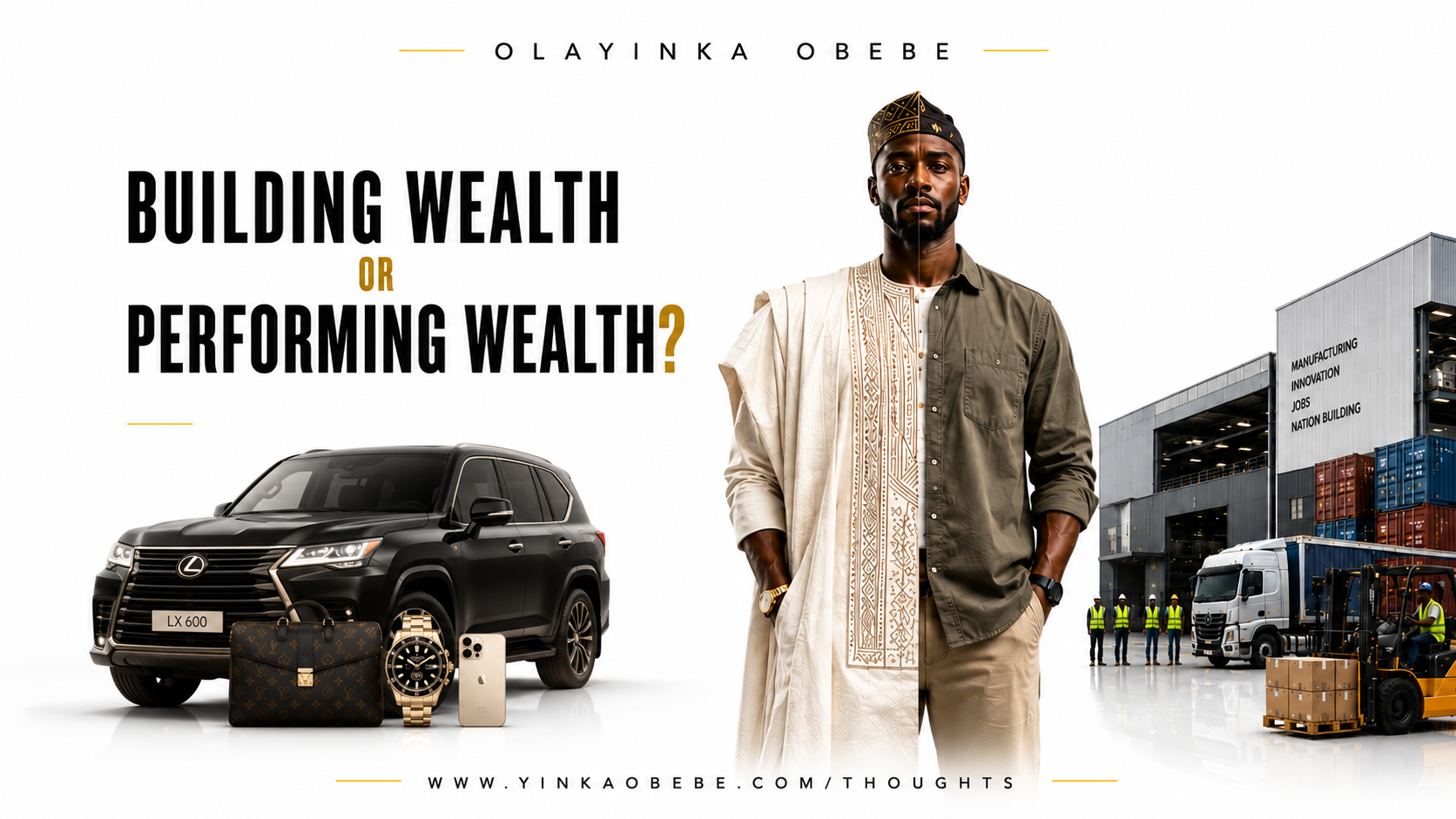
A few days ago, I made a simple comparison between two Lexus SUVs.
One was a 2007 LX470.
The other was a brand-new LX600.
What interested me was not the cars themselves. It was the reactions.
Many people argued that if you can afford the newer vehicle, you should simply buy it and enjoy your life. Others questioned why anyone would want to drive a vehicle that is ten or fifteen years old. Some suggested that once you have the money, upgrading should be automatic.
The conversation revealed something quite bigger than a discussion about cars.
It revealed how many of us think about wealth.
In Nigeria, we often define affordability as the ability to buy something. But buying something and affording it are not the same thing.
Affordability is not about whether you can raise the money. It is about whether you can comfortably absorb the cost of ownership without damaging your future options.
A billionaire that buys a private jet and a middle-class professional stretching finances to buy a luxury SUV are not participating in the same economic activity, even if both are buying expensive assets.
The object may be similar, but the economics are not.
This confusion appears in many areas of Nigerian life where we have become accustomed to treating visible consumption as evidence of success.
For instance, the car, watch, phone, apartment and the constant upgrade.
The appearance of wealth has become almost as important as wealth itself.
To be clear, there is nothing wrong with enjoying success, buying nice things and wanting comfort.
The more interesting question is why we feel so much pressure to display it.
Why is there so little dignity in driving a ten-year-old vehicle that still performs its function perfectly?
What is the hidden motivation for spend money to make older cars look exactly like a newer one, while having the same old engine?
Why does age itself become a problem even when utility has not changed?
Your transportation is already solved, the vehicle still works, so what exactly is being upgraded?
Often the story goes that, it is not utility, it is perception.
A country’s psychology can often be seen in the things its citizens are embarrassed to own.
In some societies, using something for a long time is viewed as evidence of wisdom, meaning you bought well, maintained it properly, and extracted full value from it.
In other societies, age becomes a liability because the object no longer communicates the desired social message.
The issue is not the car, it is what it says, the signal…
Many Nigerians will correctly point out that appearance is important. They are right.
A neat appearance signals professionalism, good grooming signals discipline and a well-organized office signals seriousness.
Absolutely correct, Presentation matters.
But somewhere along the line, we moved from signalling competence to signalling consumption.
Those two are not the same thing. Competence, reputation, results, building a successful company, creating jobs, and owning productive assets all communicate capability and value creation. Driving an expensive vehicle also communicates something, but it reflects purchasing power rather than productive achievement.
One is about capability and the other communicates purchasing power.
We must separate them.
Societies eventually become what they reward. When builders are celebrated, more people aspire to build. When investors are respected, more people learn to allocate capital. When engineers are valued, more people choose to solve problems. Incentives shape aspirations, and aspirations shape outcomes.
But if a society increasingly rewards visible consumption, then consumption becomes one of the most attractive paths to status.
Perhaps that is why some of the world’s most successful entrepreneurs spent years driving ordinary vehicles relative to their wealth because they understood that capital has alternatives. The luxury SUV could have been inventory, equipment, farmland, a warehouse, or simply working capital.
Every purchase eliminates another possibility.
What is often overlooked is not the purchase itself, but the opportunities that disappeared because of it.
We rarely stop to ask what else that money could have built, funded, or made possible.
Poor societies often become fascinated by the appearance of wealth because wealth itself remains scarce.
When prosperity is widespread, the people will feel less pressure to prove they have it.
Prosperity becomes something people feel compelled to prove when it is scarce.
That may be one of the great contradictions of modern Nigeria.
We are a country that urgently needs more productive capacity, more factories, more businesses, more investment, more innovation, and more wealth creation.
Yet many of our strongest social signals continue to reward consumption over production.
The issue is not the existence of luxury goods, nor the right of people to enjoy them.
The more important question is what our choices reveal about the values we reward and the future we are trying to build.
Are we allocating capital to create the future?
Or are we allocating capital to convince people that we have already arrived?