For decades, a specific narrative about development has been presented to Africans: that modernization necessitates a shift toward individualism. To truly progress, we were told, we must distance ourselves from the perceived burdens of family, community, and traditional structures. The future, according to this prevailing logic, belongs exclusively to the self-made entrepreneur, the independent achiever and the lone professional navigating the global economy unencumbered by local ties.
While this argument appears sensible at first glance, it overlooks a fundamental question: what exactly has replaced the systems we have been encouraged to abandon? A closer look at the history of global economic development reveals that it isn't a story of individuals becoming truly independent, but rather one of societies building more sophisticated systems of dependence. No successful economy is built by isolated actors; instead, prosperity is determined by the specific structures a society chooses to rely upon.
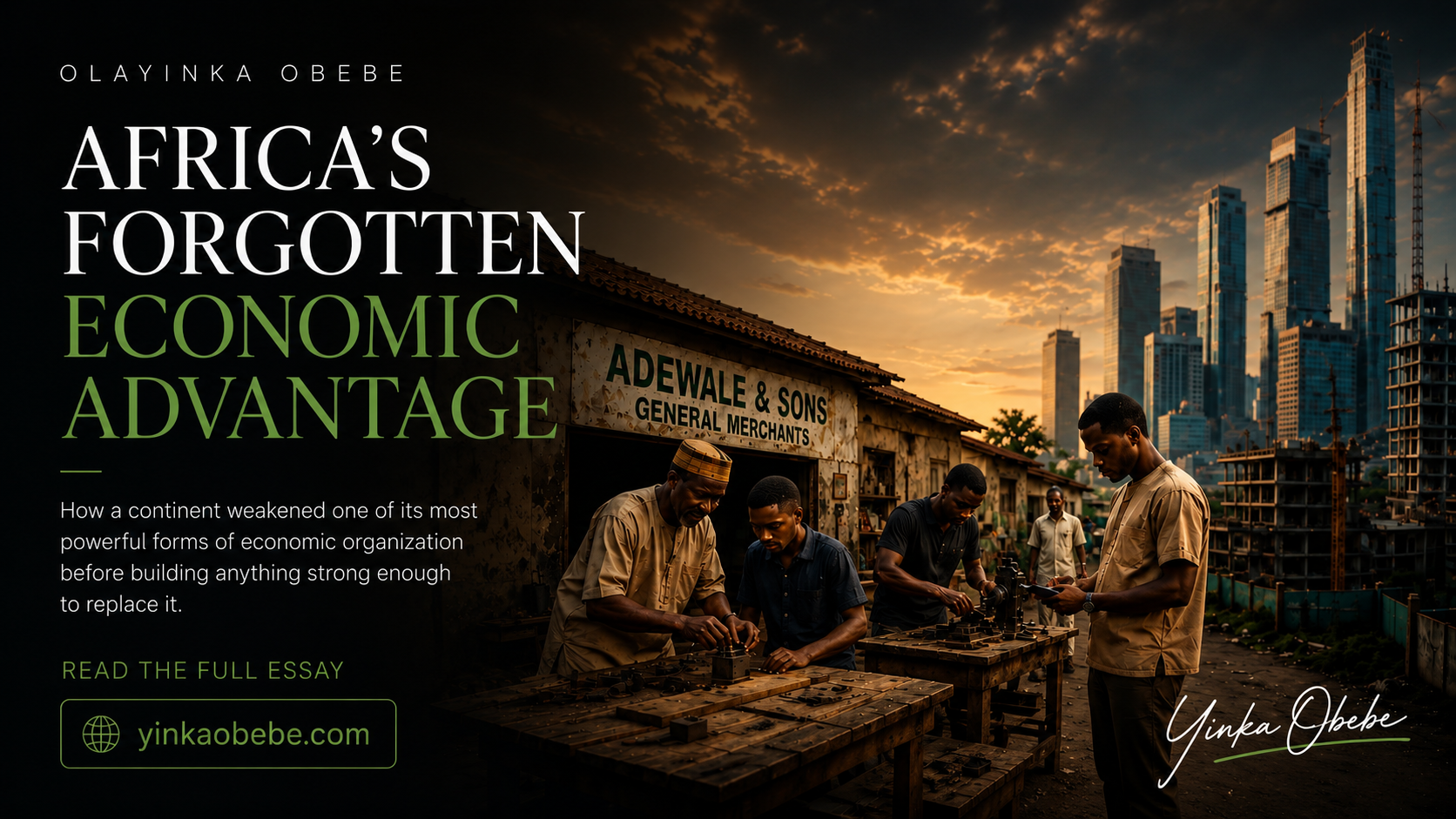
In many parts of Africa, we have inadvertently weakened our oldest foundational structures before robust modern alternatives were fully established, and the resulting economic cost may be far larger than we realize. Consider, for instance, the commercial districts of older Nigerian cities, once filled with names like Adewale & Sons, Okeke Brothers, or Abdullahi and Sons Trading. These family-owned farms, workshops, and transport companies were far from perfect, many failed or collapsed due to internal disputes but they represented a vital economic unit larger than the individual yet more agile than the state.
These enterprises served as essential mechanisms through which skills, capital, trust, and knowledge could be transferred across generations. However, today's Nigerians often view the concept of the family enterprise with deep-seated suspicion. The contemporary mantra is one of caution: never do business with relatives, never lend money to family, and never employ siblings. This warning has been repeated so frequently that it is now treated as economic common sense, despite the fact that no society in history has ever built substantial wealth without some form of intergenerational cooperation.
From the great merchant families of Europe to the industrial dynasties of America and the business conglomerates of Asia, the principle of pooling resources and protecting assets remains unchanged. The primary difference is that in developed economies, this practice has been professionalized and rebranded as wealth management, family offices, or succession planning. While the wealthy continue to practice family economics through structured governance to ensure the next generation starts from a higher vantage point, many ordinary Africans have abandoned these communal ties without an institutional safety net to catch them.
In Western nations, when family structures fragment, the market and the state absorb their former functions: banks provide credit, pension systems secure retirement, and insurance protects against unforeseen shocks. Africa, however, frequently finds itself in a precarious middle ground where weak institutions cannot fully replace strong family systems, and weakened family systems can no longer compensate for institutional failures. Consequently, individuals are forced to carry burdens that should be distributed across larger structures, leading to a cycle where every graduate begins from zero and every entrepreneur must rebuild knowledge and capital that should have been inherited.
This loss extends beyond financial capital to the realm of accumulated experience. When the specialized knowledge of logistics, procurement, and financing is disconnected across generations, society loses its institutional memory and continues to repeat costly mistakes. We see a glimmer of an alternative in traditions like the Igbo apprenticeship system in southeastern Nigeria, which demonstrates that economic knowledge can be transferred socially so that progress is accelerated rather than restarted. The lesson here is not that we must preserve traditions exactly as they were, but that we must modernize them by building governance and rules that reduce abuse while preserving the power of cooperation.
Hidden within many African households is significant dormant capital, not necessarily in billions, but in the combined value of land, small businesses, professional expertise, and networks. Viewed individually, these resources are modest; managed collectively, they form the foundation of a future enterprise. Ultimately, African prosperity may depend less on discovering entirely new strengths and more on recognizing and refining these old ones. Before we dismiss the economic power of intergenerational cooperation, we must ask ourselves: if we abandon these communal systems, what exactly do we have that is strong enough to take their place?